
Bob Creswell - 1948 to 2010
Written by Ed Douglas, August 2010
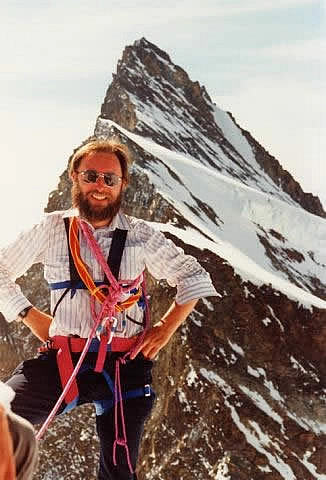
The public often assume a head for heights is the first requirement of a mountaineer. But, as Bob Creswell proved, curiosity and enthusiasm will take you a lot further. As a child, his family liked to remind him, he was so frightened of heights that he insisted on being carried down stairs. Yet as an adult, and despite a later than usual start in the hills and a demanding career, he climbed mountains on every continent, often in the company of Jagged Globe leaders and guides, who counted him a good friend as well as a capable team member.
From early forays in the Welsh and Scottish hills, he went on to explore the Altai in central Asia, climb hills in Antarctica, make an attempt on Denali in Alaska, and have a string of successes in South America, including an ascent of the stunning Alpamayo, the most attractive peak in Peru�s Cordillera Blanca. Expeditions to Africa included the Ice Window route on Mount Kenya, now a victim of climate change, and to the Atlas and the Rwenzori.
Bob also climbed Carstensz Pyramid � locally known as Puncak Jaua � in the western central highlands of Papua, Aconcagua in Argentina and Elbruz in the Caucasus, all the highest peaks in their respective continents. He thought about completing the list of the seven-highest peaks on the seven continents but reached a personal limit attempting Denali. Having sprained his ankle training in Scotland, he wasn�t, he explained, enjoying himself, and wouldn�t slow down the other expedition members. Being in mountains was about much more than simply reaching a summit. For Bob, it was a glorious chance to fulfil his lifelong passion for learning.
Born in London in February 1948, Bob Creswell grew up in Marlow, Buckinghamshire, and went to school in High Wycombe. He read Chemical Physics at Reading University and graduated with a first in 1970. Bob stayed on to do his PhD under the supervision of Prof Ian Mills, who described him as one of the best research students of his career.
Using microwave spectroscopy to study molecules in the gas phase, Bob then analysed their spectra with quantum mechanics to deduce their structure. His supervisor made two further critical interventions in Bob�s life, taking him up Tryfan while they attended a conference at Bangor, an experience that took some time to percolate. The other was an introduction to his secretary Lee, whom Bob married in December 1973.
By then, Bob was doing post-doctoral work at Michigan State University, where Lee joined him for a year. Awarded an Alexander von Humboldt Fellowship � appropriately enough for someone who later climbed his own share of South American volcanoes � he worked with Prof Gisbert Winnewisser, a dominant figure in spectroscopy and astrophysics, then attached to the Max Planck Institute, based at the Justus Liebig Institute University in Giessen.
From there Bob went to Cambridge, working for Prof Brian Thrush, whose field was the study of the rates of chemical reactions in gases. Lee worked for the head of department in Clinical Biochemistry, where she became friends with Ken Siddle, who shared the young couple�s passion for the theatre but also organised laboratory hill-walking trips.
It was on one of these in 1981 that Bob renewed his brief acquaintance with the Welsh hills, climbing Tryfan once more and then moving on to Glyder Fach�s Bristly Ridge. Except that in the intervening years, his boots had rather decayed, and he found himself with a sole flopping free of its upper and was forced to descend. From this rather unpromising start, Bob�s passion for the mountains blossomed.
Despite changing careers, leaving academia for the Inland Revenue, he became a regular on Siddle�s trips, whose personnel numbered anywhere from ten to thirty souls. They travelled all over the British Isles. A summer camping trip to Torridon revealed an antipathy to camping, which Bob retained, but his stamina for hill walking was prodigious and would think little of driving up on a Friday night to Scotland to pick off a few more Munros. He completed the list at the turn of the millennium. �They were fantastic times,� Siddle recalled. �Some of my best days were shared with him.�
In 1990, Ken took a sabbatical, and during his absence Bob decided with a small splinter group to rebel from the programme of damp Scottish hills in favour of a walking tour in the Alps. The experience was electrifying, and Bob found himself in his early forties embarking on a new career as an alpinist. An early attempt on the mighty Finsteraarhorn was curtailed on the advice of his guide, who suggested its more approachable neighbour the Agassizhorn instead. He went back a few years later and finished the job.
Without a network of climbing friends built up through a usual youthful apprenticeship, and rising steadily through the ranks at the Inland Revenue, Bob was understandably short of both time and experienced companions. Nor was he, by his own admission, a natural athlete. But he trained hard for the mountains, running the London marathon in 1997. His relationship with Jagged Globe allowed him to fulfil his growing ambition in the mountains, including his first trip to the Himalaya � Mera Peak in Nepal, with its up-close views of Everest and Lhotse.
His usual gang of friends were roped in, including Ken Siddle. It was typical of Creswell�s generous nature that he waited behind the main group on summit day as Siddle caught up, so his friend would have the best chance of reaching the top. �He said: �Come on, we�ll do this together.� I wouldn�t have got up without him,� Siddle said.
After Mera, Bob embarked on his fifteen years of world mountaineering, cramming in an incredible number of adventures. Having transferred to London, but still living in Cambridge, Bob was finally posted to Washington as part of the Anti-Avoidance Group, also becoming a delegate to the Joint International Tax Shelter Information Centre (JITSIC), a co-operation between the tax authorities of the USA, Australia and Canada.
Despite his glittering intellectual credentials, his successful career and passion for the mountains, Bob wore his learning lightly and could seem quietly reserved. He was not the kind to put his head down and push on for the summit, Bob had his camera out, or else was examining flowers or creatures. Constantly learning, he took a pre-degree course in Fine Art, and when climbing in Ecuador didn�t miss the chance to visit the Galapagos, knowing intimately the impact the islands had had on Charles Darwin.
In Mongolia, Bonny Masson recalled, Bob was always relaxed and excellent company. �He obviously enjoyed all aspects of the trip,� she said, recalling jeep rides across the steppes, dairy feasts in herders� homes and throat-singing concerts. With no sherpas to call on, the team had to carry their own loads to high camp. Bob proved himself a strong and competent climber, Masson said, as happy singing Beatles� songs with the kitchen crew as reaching a summit.
Bob could be a perfectionist, without being pedantic, pursuing woodwork to a near-professional standard. He joined an evening woodwork class in Cambridge to have access to tools, working quietly on his own, but impressing his tutor, who persuaded him to sit for a City and Guilds Certificate, earning a distinction. (The same dedication was applied to his deep love for making puddings.) He was also thoughtfully generous. Although a determined atheist, he agreed to be godfather for Ken Siddle�s younger son. Knowing the boy�s passion for elephants, he made him a jigsaw of one by hand, which remained a treasured toy.
By 2008, Bob had decided that his various passions needed more time than work allowed, so he went part-time as a prelude to retirement. Wanting to get fit for another expedition to South America, he went rock climbing in North Wales with Dave Walsh, who had guided his ascent of Mount Kenya. That evening he experienced inexplicable numbness in his right hand. This was caused by a glioblastoma, an aggressive form of brain cancer. He bore his treatment with great courage and humour, but succumbed to the disease on 21 July.
Categories
- Announcements (0)
- Blogs (0)
- News (0)
- Trip Reports (0)
- Articles (0)
Archives
- April 2026
- March 2026
- February 2026
- January 2026
- December 2025
- November 2025
- October 2025
- September 2025
- August 2025
- July 2025
- June 2025
- May 2025


