
Interview with Pasang Sherpa at Plaza de Mulas, Aconcagua
Written by Mungo Ross, February 2014
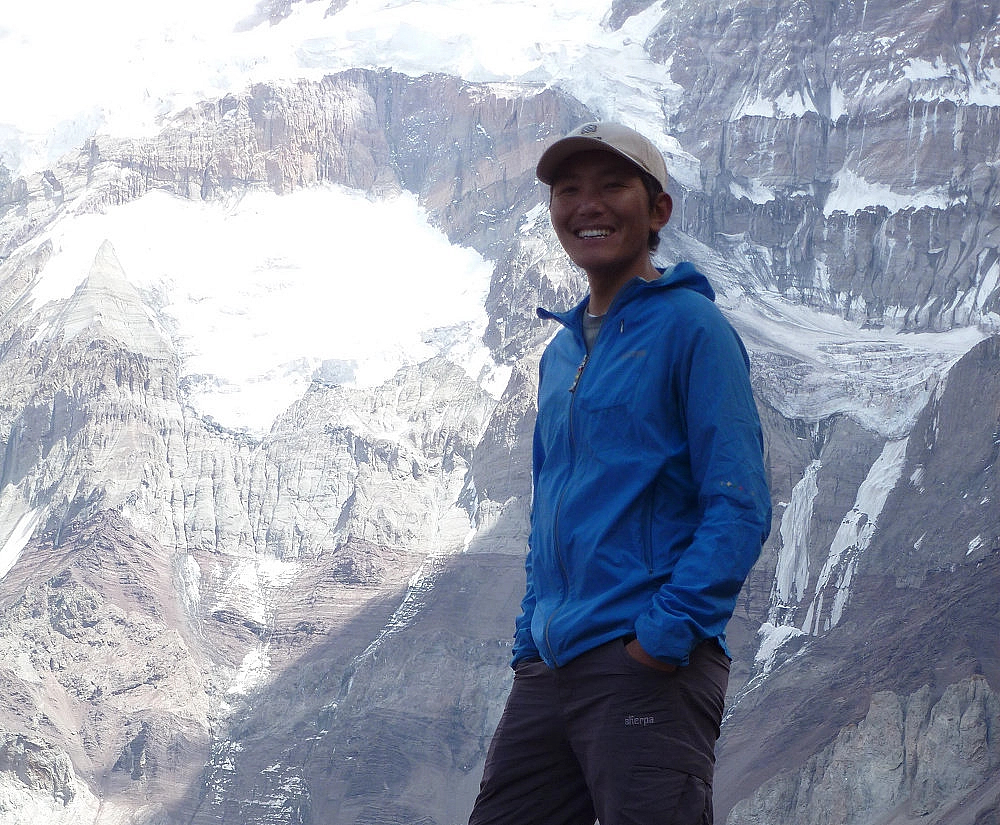
Pasang Tenzing Sherpa, 29, is one of just a handful of Sherpas who hold the IFMGA carnet, the highest qualification there is for mountain guiding. He is also an Instructor for the Nepalese Mountaineering Association. Pasang guides on Everest for Jagged Globe and regular leads expeditions in Nepal for the company. To date, he has climbed Everest 10 times. In January 2014 Jagged Globe sent Pasang to Argentina to enable him to extend his experience beyond the Himalaya, by climbing Aconcagua. Here, expedition leader, Mungo Ross talks to him at Aconcagua base camp.
21 January 2014
Mungo Ross: You are Pasang Tenzing Sherpa, 29 years old and have climbed Everest ten times to date, is that right?
Pasang: Yes, that's right.
MR: You are one of seven brothers who hold the record for the number of Everest Summits for one Sherpa family � what�s the current score?
P: We currently have 56 summits between us
MR: What made you want to start climbing and to climb Everest in particular?
P: My elder brother was already a climbing Sherpa and Everest dominated the conversation at home as I was growing up. By the time I was eighteen, I just really wanted to go and climb that mountain; my brother got me on my first trip to Everest as one of the assisting Sherpas and that gave me the opportunity to reach the top.
MR: In those days did you see climbing as a sport or as a job?
P: That first climb was just for the sake of it, but then it became a job. I went with my Sirdar brothers to the likes of Mera and Island Peak as a Sherpa, then after a lucky escape from a serious crevasse accident on Shishapangma in 2004, I enrolled for formal mountaineering training, going on to work on many expeditions � Cho Oyu, Ama Dablam, Baruntse, many of the Trekking Peaks (do you remember working together in �05 and �08?) and of course Everest every spring. I completed my International Instructor Training in France in 2008 and am now working as a trainer for the next generation of Nepali Instructors and Guides.
MR: I get the impression that becoming a Climbing Sherpa or Sirdar is a highly sought-after position for boys and young men in Nepal these days. What is the uptake for places on the training programme and the scale of your Instructor/Guides Scheme?
P: We have around 28 qualified Sherpas already, with 10 aspirants each year training; there are 33 Guides with currently 13 aspirants and 2 Sherpas per year training as Instructors.
MR: Are there any women in the Scheme?
P: I married the only Sherpani to have entered the scheme so far nearly a year ago! She is hoping to finish her training soon and hopefully will be an inspiration to other girls and young women. There are a few Nepali women mountaineers and rock climbers, but for them it is a sport.
MR: There is a lot made in the Western Media of the human congestion and abandonment of rubbish in the high mountains as a result of the commercialism of mountaineering, but I often see that amongst the local people of the Greater Ranges these are hardly issues of much significance. Do you think that this next generation of professional Sherpas see the financial benefits for themselves and their country outweighing the environmental concerns?
P: A consequence of our formal training is not only in making us all work more safely, but also with a greater awareness of our mountain environment. Learning about snow and avalanche conditions, climbing techniques, technology, weather forecasting etc. along with us all knowing each other better and cooperating more on the popular routes is definitely making it safer for everyone; and as we become better educated ourselves we are making an effort to help educate the cook teams, the porters and the local people. Certainly the Sherpas can see the craziness of dozens, even hundreds of amateurs going high on the same mountain, but that is why I am very happy working for Jagged Globe and Summit Nepal Trekking because they take this responsibility very seriously and endeavour to get the clients with enough experience onto the trips.
MR: I have to ask you - partly because you were on the mountain at the time, and bizarrely because we have just seen the movie made about it (a large-screen mountain film festival and accompanying rock band here at base camp the other night!) � about the row on the Lhotse Face last spring between Ueli and Simone and the route-fixing Sherpas.
P: Anyone using the normal route on the South side of Everest in the spring has to acknowledge that the way that the route is prepared now is for a selection of Sherpas from all of the main teams to work together going ahead to fix the ropes; it is a common understanding between the commercial companies and climbing teams that no one interferes with or gets ahead of the fixing team. Simone in particular should have known to keep out of the way that day, and they quite simply got themselves in the wrong place.
MR: Do you think that there has been long-term damage done between Sherpas and �climbers�, or was this just an unfortunate isolated incident?
P: Once the heat died down the incident was all over; Simone went on to work in the Khumbu for the rest of the season and the Sherpas got on with their jobs of fixing, carrying, looking after their clients.
MR: So what�s brought you to Aconcagua; is this your first mountain outside of Nepal?
P: Apart from some time in the Alps (and a rather soggy brief experience of the Scottish Winter scene), this is indeed my first climb abroad, and my first climb �just for fun� for a very long time! Jagged Globe gave me the opportunity to join this group and since one of my own mountaineering goals is to complete the �7 Summits�, here I am.
MR: When we met in Mendoza I remember saying to you that it seemed a pity that you needed to have to take three weeks to do what need only take you four days i.e. walk in to base camp, go up to camp 3, summit and return to base camp, go home! How are you enjoying the expedition?
P: I am having a wonderful time, enjoying a holiday, meeting lots of people and learning a lot about different ways of doing things. Although there are many similarities with climbing high in the Himalaya, particularly the need to establish a good working relationship between the Leader/Guides/Sirdar, Aconcagua has its own particular set-up and I am really enjoying spending time with the Argentinian Guides, Porters and camp crew � I don�t like using the word �porter�, I prefer to think of these guys as �high altitude workers�. My friend Sumit from Nepal is working here with his own clients and I am meeting many folk that I know already and am making lots of new friends.
MR: What is your main reaction to Aconcagua as a mountain so far?
P: I am surprised at how difficult it is to climb! I have met a lot of people already who are back here for the third and even the fourth time trying to get to the top. It is certainly not the case that you can expect to roll up here and just walk up the path - it�s really hard! The changeable and extreme weather, the very demanding conditions and the altitude make it feel more like an 8000 metre mountain in Nepal, with all the associated seriousness and the need for considerable experience to have any chance of summiting. A lot of folk seem to have underestimated the challenge of climbing Aconcagua, perhaps because it is often referred to as a �non-technical� ascent, an �easy� 7000 metre peak; and only give themselves a limited time frame for the ascent � you need to be acclimatised and then be prepared to wait around for the weather windows, which can be very brief.
MR: Well good luck with your own attempt. Let�s hope that we get lucky with those windows. What are your plans after this?
P: I am busy with my various voluntary roles in Nepal - Secretary of the Nepal National Mountain Guides Association; Treasurer of the Nepal Mountaineering Instructors Association; and President of the Mount Everest Summiteers Club of Rolwaling, which is the valley in Nepal that my family are from and where I will be running training courses in February for some of the locals. We'll be doing first aid, crevasse rescue, navigation and teaching climbing. Then it will be back to Everest at the end of March, oh yes - and see if I can spend some time with my wife!
Footnote; The team did indeed get that illusive weather window, the group that Pasang joined having been whittled down to a group of one team member, Nanika our local guide and myself logistically deciding to make a summit attempt by going from base camp to camp 1, then to camp 2, on to camp 3 and from there to the summit back to camp 3, back to base camp on day 5; no rest days or contingency. Pasang hung back for a day coming from base camp to join us in camp 2, then strolled up to camp 3, made the summit and dropped back to base camp the next day while we enjoyed another stormy night at 6000 metres! The advantage of being acclimatised, extremely fit and a thoroughly competent high altitude mountaineer: 2 down, 5 to go � good luck to you Pasang.
Categories
- Announcements (0)
- Blogs (0)
- News (0)
- Trip Reports (0)
- Articles (0)
Archives
- April 2026
- March 2026
- February 2026
- January 2026
- December 2025
- November 2025
- October 2025
- September 2025
- August 2025
- July 2025
- June 2025
- May 2025


