
Mount Ararat - September 2023
Written by Team Member Michael Peakman (Mick), September 2023
Having not done an overseas expedition for several years due to COVID, I wasn’t sure if the passage of time had dulled my enthusiasm for tents, trails, and tough days on big mountains. It hadn’t, so after reviewing the offerings, chose the Mount Ararat trip which seemed to combine hotels and sightseeing with camping and climbing in a satisfactory mix. It would also be my first trip to Turkey, so I was keen to see a bit more than just a couple of mountains.
Previous reports pretty much cover the basics and, given that it is a good and successful mix, little has changed over the years itinerary-wise. However, for our trip there was one significant change which will be described later.
Our team had a good range of experience and no-one on the trip could be described as a novice by any stretch, so we all knew what was to come. We were also an international team with one from Switzerland, a couple from Belgium, two from Sheffield, one from Manchester, a couple from Exeter and me from the wilderness of Gloucestershire.
Via various means, we all met in Van at the Conforium Hotel which, apart from not selling alcohol of any kind, was an excellent choice; the rooms were vast, the staff eager to help and the breakfast comprehensive.
I should mention at this stage that Turkish meals follow a similar pattern; breakfast is a buffet of salads, olives, dips of various kind, boiled eggs, bread of varying type and freshness, cheeses both hard and soft and small buns that were tasty but hard to describe. Lunch and dinner are huge! As soon as we sat down at a restaurant, waiters swarmed us with pre-starter dips and bread and, quite frankly, even before the starter, we were full. Generally, starters are soup of some description and the main course often kebab related although Lasagne and Turkish pizza (Pide) were popular dishes. Tea is obligatory and accompanies every meal regardless, being served in small glasses without milk. I am not a tea drinker and frankly it tasted just like PG Tips to my palate, but others enjoyed it. Coffee on the other hand, takes one of two extremes, it is either from a sachet and contains milk powder, tasting rather bland, or it is traditional Turkish coffee which ought to come with instructions and a health warning. Try it once just because you are in Turkey, but like me and others on our team, don’t repeat the exercise, ever.
The sightseeing part of the tour included Akdamar island and church, a forty-five-minute boat ride, from which, excellent views of Mount Artos, the acclimatisation peak, were to be had. The island, in addition to the church has toilets, a café and a small gift shop but nothing else.
Van castle was visited early evening which is probably the best time for a visit to watch the sun go down over Lake Van, Turkeys largest lake. We also visited the Ishak Pasha Palace, which proved popular with everyone. One thing to be aware of though is that some of the roofs and doorways are very low, two of us managed to hit our heads on the same roof exiting from the dungeons at the same time, you have been warned.
Mount Artos (3,550m), our acclimatisation peak is a real adventure. Getting to it involves a mini-bus ride to Gevas where we changed to a rickety old mini-bus which took us part way up the mountain to 2,600 metres. The track is in very poor condition, and we rocked and rolled our way up, even having to pause at one point to allow the engine to cool off. We did muse on whether we would have to pause similarly on the way down for the brakes (we didn’t). The walk itself is a steady one to the halfway point on a good track, then the ridge is gained via scrubland but easy going and finally following the ridge, the summit appears quickly. It is worth taking an extra layer to combat the wind that suddenly appears at the halfway point and can be significantly cooler than the lee side. Up and down took around four hours of steady walking to cover the 11½km round trip, but we’d set aside an entire day so the timing, whilst interesting, is largely irrelevant.
Ararat is climbed traditionally by ascending from the trailhead to Camp 1 on day 1, then part way to Camp 2 on day 2, up to Camp 2 on day 3 and then the summit attempt on day 4. The weather forecast for our trip had snow and bad weather on our summit day so, after a discussion, we all agreed that we would forego the ‘part-way’ day and ascent higher each day which would bring the summit day back to day 3. It was an aggressive profile but, as I mentioned, everyone was sufficiently experienced to understand the effects of this. Some elected to use Diamox as a way of mitigating the issues that might have arisen otherwise.
Of course, anyone considering doing this climb doesn’t need to be told about the benefits of consuming significant quantities of water regularly. It is not an issue as there is plenty of water available at both camps and it worth taking containers to allow 2½ to 3 litres to be carried each day. 1½ litre bottles of water are usually available from the local shops but should not be relied upon, and the next size up of 5 litres is probably a too much and too heavy to carry (5Kg).
As it turned out, apart from one team member who had been suffering from a stomach bug and took the wise decision not to attempt the summit, everyone else succeeded in reaching the top. This made it one of the most successful Jagged Globe expeditions to Ararat, we were told.
The mountain is relentlessly steep all the way, there are no cols, no plateaus, no easy sections right from the get-go. It seems to get steeper but always walkable, as altitude is gained, but that might just be that it seems steeper due to the thinner air and cumulative effort. Summit day is cold (-15C with the added windchill). I’m always reluctant to recommend clothing as it is a very personal choice but, from the start, I wore a thermal base layer, a mid-layer and a lighter weight down jacket plus winter trousers and over-trousers for warmth, medium gloves and a beanie hat. Even then, I got a little cold, so I added a hardshell, double gloves and a Fjallraven Singi hat. My boots were Scarpa Manta GTX which kept my feet warm enough. Boots are not necessary up to Camp 2 and trekking shoes can, and indeed were worn. Boots need to be able to take a crampon. You should practise beforehand to ensure they can be put on with gloves because it can be extremely cold when the glacier is reached, and bare fingers will chill very quickly. Walking poles are essential for balance on the slippery, loose ground both up and down.
Timing is wide ranging and very much depends on the group. None of the days are excessively long and, in fact, other than summit day a relaxed approach to the ascent is preferable. Having said that, our timings were (not including stops):
Trail head to camp 1: 3 hours (8km)
Camp 1 to Camp 2: 2 hours 15 minutes (2½ km)
Camp 2 to Summit: 5 hours (5km)
Summit to Camp 2: 2 hours 45 minutes (5km)
Camp 2 to Camp 1: 1 hour 30 minutes (2½ km)
Camp 1 to Trailhead: 1 hour 50 minutes (8km)
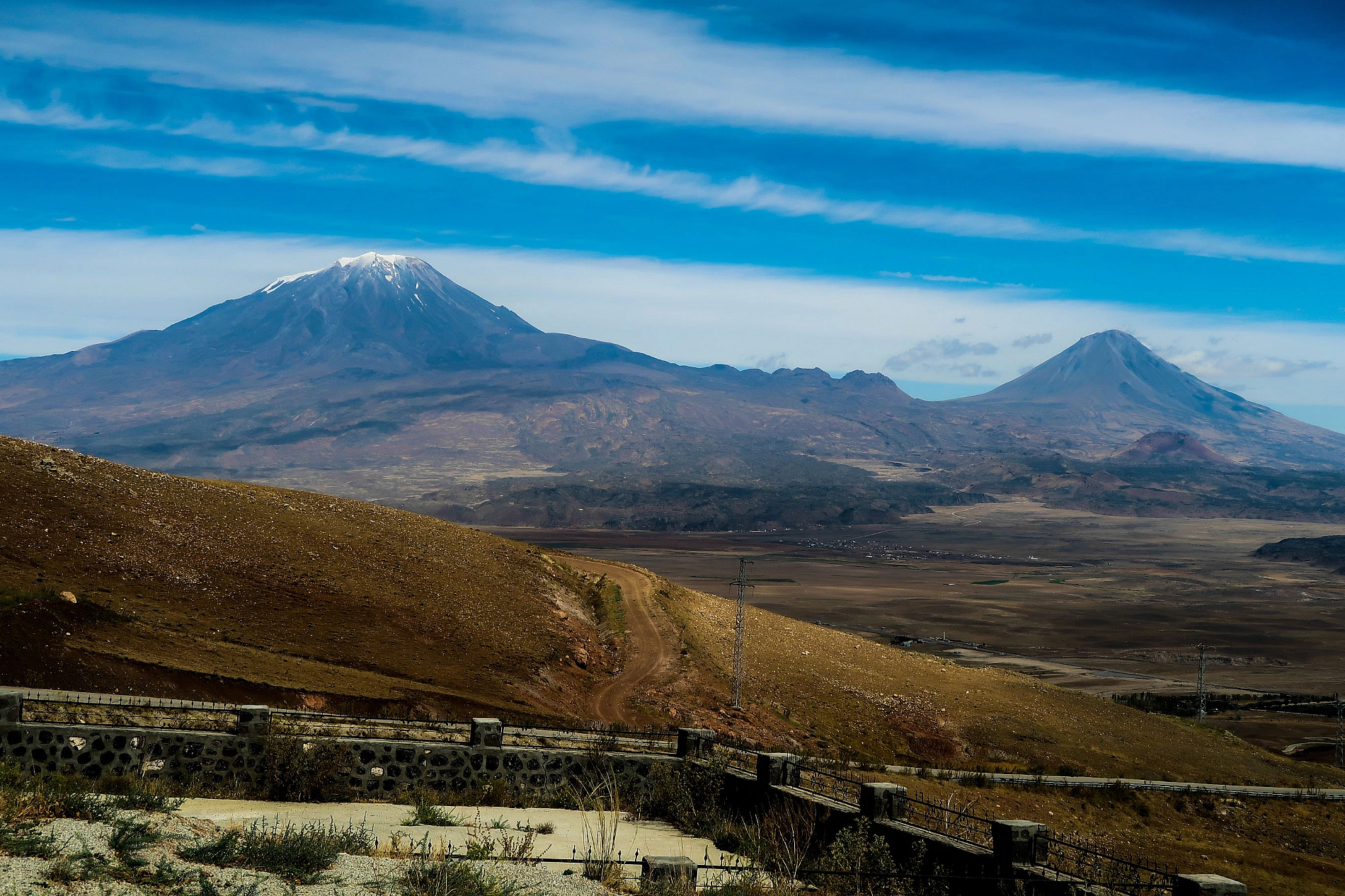
Given that we’d finished a day early, we elected to go back to the hotel in Dogubayazit for an early shower and civilisation. This meant we had extra time and, the following day, before driving back to Van, we decided to visit the Noah’s Ark, which is just a few miles out of the town. This was very interesting and it stimulated some friendly discussion amongst the team about its origins. In addition to the Ark, there is a phenomenal view of Ararat and little Ararat from the site too, which we all enjoyed.
Our final night in Van saw us at a steakhouse that served beer and other fermented products that some had been yearning for. However, due to an earlier Turkish “light-lunch” (so called), most people could not really do it justice. Nevertheless, it made a nice change and the beer and wine helped us celebrate our success in style and also the birthday of Geert, our Belgian friend. Cake was provided with sparkling candles to accompany our rendition of the traditional birthday ode.
One of the great joys of a Jagged Globe expedition is that all you need to do is to turn up and climb the mountain; everything else is taken care of to the finest detail. Thanks must go to the office team at Jagged Globe House for their excellent work as we couldn’t do it without you!
Also, a successful team depends on the team members, and I was fortunate to be climbing with an excellent group of people, so I thank you all for your humour, support, encouragement and general good nature. If Carlsberg made teams, this one would have been it.
« Previous report | Next report »
Categories
- Announcements (0)
- Blogs (0)
- News (0)
- Trip Reports (0)
- Articles (0)
Archives
- April 2026
- March 2026
- February 2026
- January 2026
- December 2025
- November 2025
- October 2025
- September 2025
- August 2025
- July 2025
- June 2025
- May 2025


