
Wilhelm and Giluwe 2025
Written by Leader Robert Anderson (Robert Anderson), July 2025
Where exactly is this place?
Awake—where?
Oh yes, a grass hut deep in the jungle.
Bird calls echo over the hillside — chirps, caws, bassonic hoots, and what can only be described as the trumpet of something unseen flapping its way through the canopy.
The jungle is alive with sound, near and far, layered and loud, the jungle itself just waking up.
We’re in Papua New Guinea — though to pin it down with a dot on a map feels challenging, even amongst a group who have all the seven continents and 100’s of countries and high points between them. Somewhere beyond Port Moresby, below Mount Hagen, right at the end of the road it seems.
Here, in the Southern Highlands, we’ve stepped into a place where the local people live in a way that feels both timeless and entirely of the jungle and mountain place, quite removed from the rest of the world.
We visit tribes where their ceremonial dress is heritage, identity, and protection. Tradition is worn: sometimes to ward off enemies, sometimes for festivals, always for weddings and funerals.
We’re visitors here of course. But also, with the opportunity to immerse ourselves, to be a small part of it for a short but intense adventure
Our group is a mix of nationalities and backgrounds — the UK, Norway, South Africa, the U.S., and New Zealand. Sailors, pilots, outdoor leaders, executives, nurses, seasoned climbers and global adventurers. We met only days ago, but already the differences are fading. The jungle doesn’t care where we are from, we just need to see how high we can climb.
Touching the top of the tallest volcano in Oceania, climbing up the granite spire of Mount Wilhelm, which if you slice the world up politically, would be what could be considered the 10th of the seven summits, is our goal.
Yet in many ways, the mountains are just a backdrop for climbers, and the overall adventure is what we are here for, the immersion in a country and a culture that feels very much like a far, far away place.
Fortunately the master of global guiding, David Hamilton, with a background across all the 7 summits, the 7 volcanos and 10 ascents of Everest, has laid the plan and been here before us to sort the rather obscure logistics in a land where the word logistics doesn’t translate well. He’s opened the door and we are very happy to follow in his footsteps.
What we found — through wet boots, steep bogs, slippery roots, shared effort and many cups of tea — is common ground amongst our team, across a host of diverse backgrounds.
Adventure has a way of leveling things. And here, far from the noise of the world, we share stories, the adventures we have had, the one we are on, and always, where we will go next.
We’d left Singapore for the 6 hour flight to Port Moresby airport, with the transition to the domestic terminal already feeling like we were quite a long ways away. Outside, people sat in clusters on the pavement in brilliant colours, the tropical heat pressing down like a blanket.
We flew inland on an aging Fokker 70 to Mount Hagen, as no roads connect many parts of the country, the terrain being just a bit varied, all steeply up and down, with dense jungle and few people.
From Mount Hagen the road led through villages clustered along the road, then farms and finally became a single road track twisting steeply up into the hills. Rain fell. The van slid. Momentum carried us forward.
Giluwe is a magic mountain — volcanic spires rise from cloud-blanketed valleys, surrounded by tribal land, wildflowers, and echoes of earlier ascents. The trail led up through the jungle, into grasslands with immense tussocks. Our porters wandered amongst us, many barefoot and far more sure footed, connected directly to the earth. We camped amongst the grasslands, our only night of the journey in tents, set under the stars, so very many stars.
Pre-dawn we were off again, into the heights, the trail weaving upward, the sun soon to rise orange and red out across the jagged hills, a very jagged globe indeed. For a volcano, the way was steep, the route finally leading nearly vertically upward towards the summit, with a chain and a cable to clutch too as we traversed terraces set stair like below the top.
The day was clear, bright, crisp, we’d escaped the jungle and were suspended in the heights, views extending to the far horizon. The dark jungle rose in waves to the hills around us, while we were alone on the summit beneath the orb of the deep blue sky.
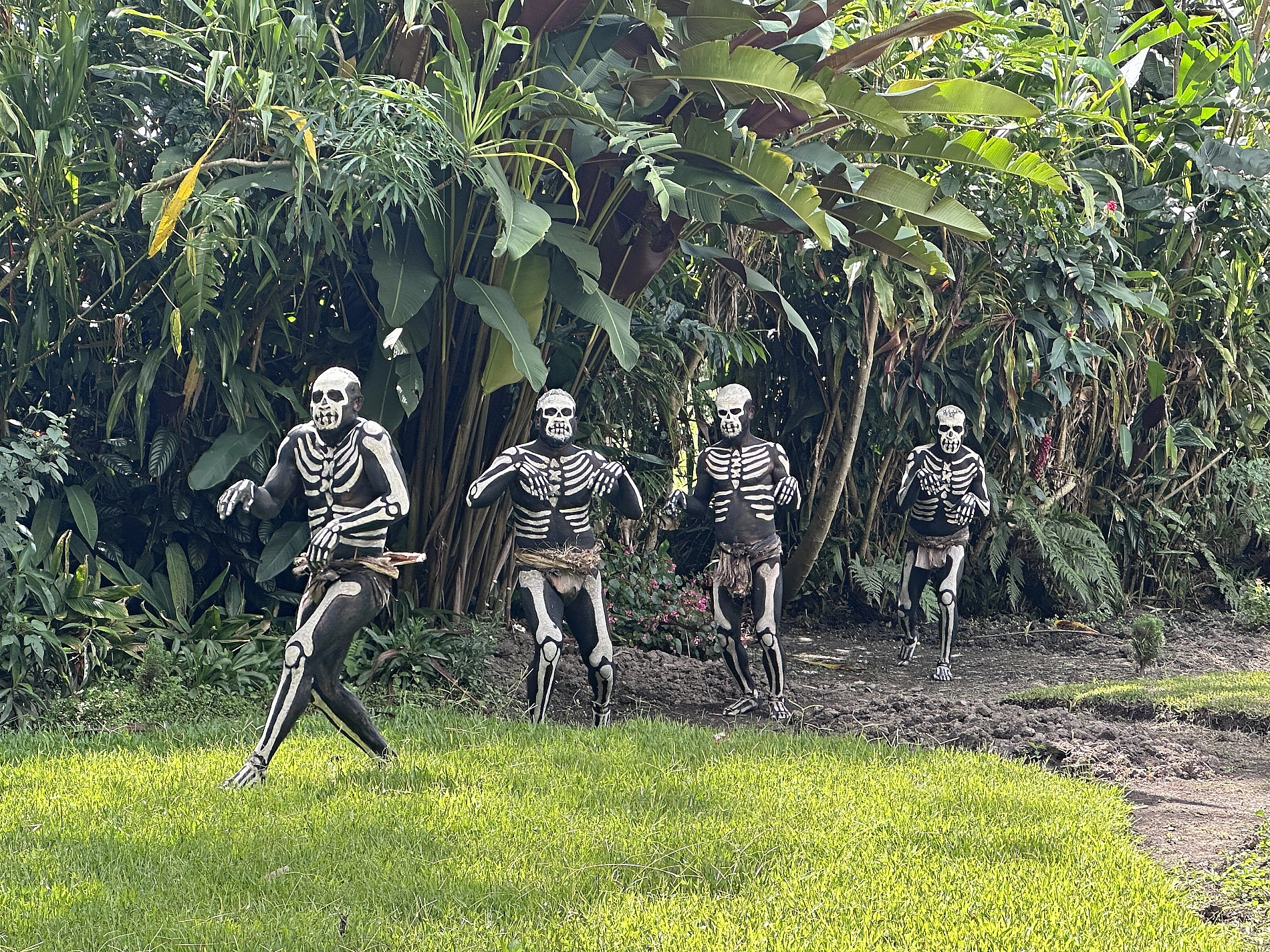
In the valleys below, we’d met the mud men, the skeleton tribe, bird-men in feathers and paint. They congregated in grassy paddocks amongst the jungle for us as we arrived at each of their tribes’ gathering points. There wasn’t a tightly set timetable, no-one else was there, there were no chairs, no signs.
The mud men emerged silently and other worldly from the cave of the jungle and walked towards us, mimicking the way they protected their villages from marauding tribes in the past, looking like jungle spirits with their mud paint, full head helmets and long exaggerated sharpened fingers on each hand. Seeing them, the only natural human reaction was to run away, far away.
The wag men were feathered, plumed, grass clad and painted, more for festivals, weddings and funerals. They danced by jumping up and down.
The Skeletons were about as creepy a thing as imagined. Black paint thickly caked them, white bones drawn along their skin. They scare other tribes away, protect babies and live in caves, coming out to show themselves for tribal events. Once their initial stomp out of the jungle, their walking past closer than was comfortable, they shook off their outer visages and told us their stories. There were no tour guides, no theater, and the donation box was a cereal box on the tree you would be lucky to even see.
Our ascent to the top of Gilwe complete, we were treated to a full dinner cooked over stones, encased in leaves, layered with taro, sweet potato and lamb, then sealed in the earth, roasted and steamed in an earthen oven. We ate with our fingers, juices dripping.
We left the rustic, scenic terrace of Magic Mountain lodge the next day for a 5 hour drive through the jungle, past farms and villages to the slopes of Mount Wilhelm.
Betty’s Lodge is a Highlands haven — big wooden rooms, solar powered hot showers, garden terraces stretch out in all directions, a trout farm sits next to the river below.
Every meal was fresh: home-made bread, strawberry cakes, potent Papua New Guinea coffee and trout brought up from the farm each day; and that was just breakfast.. In the evenings, we warmed up beside a wood stove, sipped cool beverages before dinner, while eying the wine rack. It was simple happiness.
From Betty’s Place, we moved up onto Mount Wilhelm — PNG’s highest peak. The trail angled gently up through the jungle, then broke out into a grassy valley cut by a stream. We finished the day alongside a crashing waterfall and climbed into a wide alpine basin, where a cold black lake sat cupped below towering cliffs.
We spent the night in a weathered hut with views across the valley and up to the heights of Mount Wilhelm looming far above us. It did look like a proper mountain, all 4,503 (14,770 feet) of it. We tucked into a full buffet and were asleep on our mattresses as darkness settled around.
At dawn we were already 500 metres above the lake, making a steady ascent along misty ridgelines and out onto the broad slopes stretching into the high sky. The morning was lit by a brilliant orange dawn before the clouds returned and wrapped us up in grey.
The final approach was a rewarding hands-on scramble over the solid black granite to a pinpoint summit. A patch of blue resonated overhead but the views had to be remembered from our brilliant summit of Giluwe only a few days previous, as clouds swirled around us and mist clung to the ridges – atmospheric and enveloping.
Each of us had been paired with a local guide, seemingly a bit enthusiastic, but in the end, they were never overbearing, wandered along close by when we needed them and were happy to point out the best rest stops and travel with each of us at our own pace.
It also was a way to give back to each of them in a place where there is little real employment. Our guides were not just mountain born, but also mountain savvy and added an unexpected depth of understanding into their way of life, their families and their tribes.
With long bush knives in hand, they cleared paths, prepped meals, and could flick a knife at a passing bird, whipping it through the forest like a frisbee, in an instant. They knew every twist of the trail and shared stories of village life, family, and growing up in the hill far from any roads or civilization..
Speaking fluent English, laughing with us, they offered a rare glimpse into a culture with 840 languages and probably just as many tribes, tucked away in every valley and along every ridge in the country. .
The descent from Mount Wilhelm took us from the top of Papua New Guinea to the long rambling trail cutting across the slopes, until a final long drop to the lake returned us to the valley. And for a select few, a canoe-like clear plastic row boat set out across the lake, they were picked up and paddled enthusiastically back to the hut, a fitting finale to the long climb.
Our welcome back to Betty’s Lodge was no less warm the second time. Our hosts — Welsh, Australian, PNG-born — treated us not as guests, but as family, taking us on tours and for coffee with the local villagers, to visit the school and talk with the teachers and for an afternoon of coffee and betel nut chewing, just to ensure we got back up the hill and home for dinner.
Yes, there are still places in this world where no one is watching. Yes, there are still cultures hidden away in the forest, living fully and never venturing more than a few miles of home. And yes, with a garden, a pig or two, and a good bush knife, a place where life is simple and happy.
Want to go next year? Why not? There are not that many great adventures and this is certainly one of them. One of the few places I’m thinking about actually returning to – unique, stunning, amazing culture and spectacular mountains.
« Previous report | Next report »
Categories
- Announcements (0)
- Blogs (0)
- News (0)
- Trip Reports (0)
- Articles (0)
Archives
- April 2026
- March 2026
- February 2026
- January 2026
- December 2025
- November 2025
- October 2025
- September 2025
- August 2025
- July 2025
- June 2025
- May 2025


