
Antarctic Climber - 5 December to 20 December 2001
Written by Leader Steve Bell, December 2001
Our second Antarctic Climber this year took place in December. Six climbers joined Steve Bell on the Polar Pioneer, an excellent ship manned by Russian crew and Australian cooks, doctor, lecturers and bar staff. The ship was our base as we cruised along the Antarctic Peninsula and stopped to climb suitable peaks. Other climbers were also on board, and the overall team was led by Australian mountaineer, Greg Mortimer. About half of the 56 people on board were interested in doing some climbing, while the remainder were there to simply see Antarctica. Several climbers came with their non-climbing partners.
A rapid 36-hour crossing of the Drake Passage from Ushuaia in Argentina took us to our first Antarctic experience, Aitcho Island in the stunning South Shetland Islands. Here we had a glimpse of things to come, with wonderful landscapes and the abundant wildlife – birds, seals and penguins. Next morning we arrived at Esperanza, an Argentinian base on the tip of the Antarctic Peninsula. The weather was perfect, with blue skies framing the mountains and icebergs, so we got ashore as quickly as possible to climb Brown Bluff, a 700m high glacier dome atop steep brown sea cliffs. Despite cloud cover appearing during the climb, and strong winds, the view from the top was fabulous. We were right on the tip of the Antarctic Peninsula, and we could see its mountains curving away to the south. Below us, jagged icebergs sailed through the narrow straight of Antarctic Sound from the Weddell Sea, where a vast flotilla of bergs stretched to the cold horizon. It was fantastic! We were back on board the polar Pioneer for a late lunch and enjoyed the hospitality of our Argentinian friends at Esperanza in the afternoon.
The next day we arrived at Deception Island, a huge volcanic caldera, which has been breached by the sea and flooded to form a sea water lake several miles wide. In our Zodiac inflatable boats we made an exciting surf-borne landing on the outside of the island, at Baily Head. This is the home of around 100,000 chinstrap penguins, and being there can only be described as a “David Attenborough experience”! Returning to the ship, we sailed through the gash in the crater to the calm waters of the sea-lake, and went ashore at Telefon Bay for a fascinating walk along high ridges of volcanic ash.
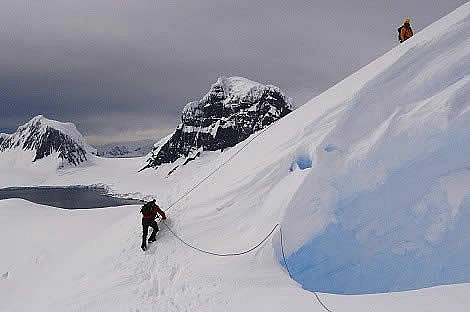
That night we turned south and the following morning stopped for more wildlife viewing at Cuverville Island. It was snowing and visibility was poor, but we had our eye on an unclimbed peak at the south end of nearby Rongai Island, so we gave it a bash. It was amazing to get out of the Zodiac and start climbing 60 degree snow straight off the beach rocks! Higher up the snow was avalanche prone so we veered right onto hard ice for a few pitches until more snow led to a large shoulder close to the summit. The sun came out for a while, providing magical views of the sea, icebergs and mountainous islands. But the recent snowfall had loaded the slope ahead, and made further progress unwise. Greg and Steve unroped and climbed a further 100m to check it out, but the decision to turn back was not hard to make. However it was an exciting climb and we all buzzing by the time we got back on the ship. Then we sailed into pack ice, and spent much of the evening on deck, watching the bow slice through the lumpy ice, with crab-eater and leopard seals sliding off their floating ice perches to get out of the way. For most of us, this was what Antarctica was all about.
In the morning of the next day we were still in the pack ice, the Russian Kapitan picking a line through it to avoid the larger lumps, while keeping a watch on the sonar for hidden rocks and shallows. Now we were in the renowned Lemaire Channel, a sea-filled gorge flanked by some of the most impressive peaks you can imagine. Some have been climbed but most of them haven’t – it is an alpine playground of the future. We intended to sail to the end of the channel where there were some grounded ice-bergs on which we wanted to climb. But unusually for the time of year, we were blocked by sea-ice, still frozen from the winter. You’d need an ice-breaker to get through it but the Polar Pioneer is not an ice-breaker (it is “ice-strengthened”). We rammed into it several times, but only got a ship’s length into it, so we stopped and got off! Stepping of the ship straight onto metre-thick sea ice was something else. Some of us walked across it for a mile or so to the shore where an ice-cliff promised some good sport, but the wind was vile and no-once wanted to hang around. Walking into the teeth of the wind and sleet back to the ship gave everyone a taste of grim Antarctica, just for a few minutes until the cosseting warmth of the ship rescued us.
We sailed north to the British Antarctic Survey outpost at Port Lockroy, the UK’s most southerly post office. A tempting peak behind the base caught our eye, and a large team of us set out for it after supper. The glacier trudge soon became more interesting as we rounded onto a blunt snow ridge. Buffeted by the wind (again!) we broke through a cornice and followed the upper ridge to the summit, reaching it at about midnight. Below we could see the ship parked in sea-ice next to the base, and all around us steep mountain ridges glistened with hard climbing potential. As we descended, the wind increased so much as to knock us off our feet and blow lightly laden rucksacks over our heads, adding a little spice to the climb before getting back to the ship’s bar for a late night-cap.
Now we were making our way north, with only one more day in Antarctica. Re-crossing the Bransfield Straight, we returned to the South Shetlands and stopped at Half Moon Island, just off the impressively mountainous Livingstone Island. Most people stayed on Half Moon to get their last photos of seals and penguins, but a few of us made a the Zodiac trip to Livingstone Island, to one of the few landing spots along its inhospitable coastline of calving ice-cliffs. We climbed a lovely little peak on the northern-most ridgeline of the island, which culminated in a pointed and photogenic summit. The other side of the peak dropped away very steeply to the sea on the opposite side of the island, so we could hear the waves crashing on the rocks below. It was weird standing on top of a snow covered peak and hearing the sea!
All too soon, it was time to return to Ushuaia. We had been very unlucky with the weather, as we’d only had a morning of blue sky on the whole trip, which is unusual. However, we had a great time, made the most of the climbing available, and experienced some of the many wonders of Antarctica.
« Previous report | Next report »
Categories
- Announcements (0)
- Blogs (0)
- News (0)
- Trip Reports (0)
- Articles (0)
Archives
- April 2026
- March 2026
- February 2026
- January 2026
- December 2025
- November 2025
- October 2025
- September 2025
- August 2025
- July 2025
- June 2025
- May 2025


