
Kyajo Ri - October/November 2016
Written by Leader Tony Halliwell, December 2016
“Kyajo Ri is an ideal objective if you want to climb a 6,000m peak in the Everest region with more technical interest than many of the popular trekking peaks.” (Jagged Globe website)
“I think that it's fair to say that the load carrying is one of the hardest challenges that you face in climbing Kyajo Ri.” (Matt Parkes, exped leader 2105)
Both of the above statements are totally, utterly true. Kyajo Ri is a fantastic objective, well worth the extra effort and truly satisfying because of that extra load-carrying (in comparison with many trekking peaks). This mountain is a great way to challenge yourself at a relatively modest altitude.
Kyajo Ri’s challenge isn’t initially obvious and it is possible to get lulled into a false sense of relaxation. Approaching Kyajo Ri couldn’t be easier (if you wanted to limit your chances of success); just trek up to Namche, turn left and you could be at the mountain’s base camp in a day or two. But then you’d not be very acclimatised and boy might you suffer accordingly.
Instead, Jagged Globe’s adherence to recommended acclimatisation profiles (to give climbers the best possible chance of success) means that our route takes us up to Namche, where we turn right and do an acclimatisation circumnavigation of the peak, from 6 o’clock, anti-clockwise, virtually all the way round to 7 o’clock, before we start trundling up to the base camp.
That’s exactly what Ankit, Carl, Deborah, Hannah, Mark, Mike and I did in late October this year, accompanied by our sirdar Pema, our climbing sherpas Mingma and Kilu and Pema’s excellent team, amongst whom our amazing cook Mani received daily praise for his fantastic food.
To begin with, after arrival in Kathmandhu, some pairing down of gear to get close to the Lukla flight weight limits and an early departure from the domestic airport, you could be doing a relaxed Gokyo trek. This year though, our first few days caused a few misgivings in the minds of the team. Cloud was low and the nights were warm. The views weren’t brilliant and when we did our customary acclimatisation walk from Namche up to the Everest Hotel, then on to visit one of the bakeries in Khumjung, it might as well have been the Misty Hotel, because Everest was refusing to show itself.
Sticking to our acclimatisation profile, the first few days out of Namche were remarkably short and relatively easy; a short day to the Mong La, a short day to Dole, a short day to Macherma – yet these all conformed to recommended height gains and, despite this relatively slow pace of progress, headaches started to be felt.
Our step change presented itself on our Dole to Macherma day. We woke up to our first frost after a clear night and as it turned out, this was now the pattern for the rest of our trip, with good, settled weather and blue, blue skies.
At Macherma too, we got our first view of our mountain – looking pretty steep – though not as steep as it would be for the group of Russians who we heard were attempting a new route on its north face.
On we walked. At Namche we’d rubbed shoulders with Mal Haskins’ Cholatse group and as we trekked towards Gokyo we looked up at the stunning line that they’d be following. At Gokyo we had another customary acclimatisation day, with an early start up to Gokyo Ri – before dropping back down – only to climb high again the next day as we travelled over the Renjo La.
Trekking up to and over the Renjo La accounts for getting on towards half of the trip and it’s very easy for climbers to be chomping at the bit/wanting to get on with the climbing, but all this altitude gain and loss is getting deposited in the acclimatisation bank and getting us ready for the mountain – and it’s not surprising therefore that there is a feeling of step change as you descend to Thame. For a start off, you get another view of the mountain, the col where its high camp is situated and a glimpse at the line we climb. Secondly, the mountain starts to feel close in time. Ascending to base camp was only a couple of days away and our climbing group were all feeling pretty much ready. In Gokyo the weather forecast had been unsettling; likely fresh snow and very strong winds. By the time we got to Thame the picture had changed – perfectly for us – no new snowfall and, yes, strong winds, but these dying down just at the point when we’d be getting onto the mountain itself. It could not be better – and we were getting close.
The climb from Mende to base camp reinforced the feeling of step change we had been sensing. The trails thus far had been busier than usual and it would seem that the folk who didn’t come to Nepal last year had added to the numbers who had planned to come this year. But suddenly (and only a few stones’ throw from Namche) we had a feeling of remoteness and splendid isolation. The trail up and into the Kyajo Drangka valley is steep and indistinct and the terrain is rough. More than that, we just left other people behind. We had the valley to ourselves; we had the mountain to ourselves – and that’s the way it stayed.
Base camp valley itself is pretty remarkable. There’s a headwall to a higher hanging valley and that headwall looks fairly impregnable. Not surprisingly, it isn’t. The upper hanging valley is accessed via a couloir – taken by the line of our route after we had established camp and after a day of practising the required techniques for safe negotiation of fixed lines in ascent and descent.
Time for another step change and time for a bout of ill-health to strike for Deborah at the worst possible moment, making it impossible for her to continue, though she gave it her best shot, starting up to camp one on the first of two carries. This is when the challenge of load-carrying presents itself.
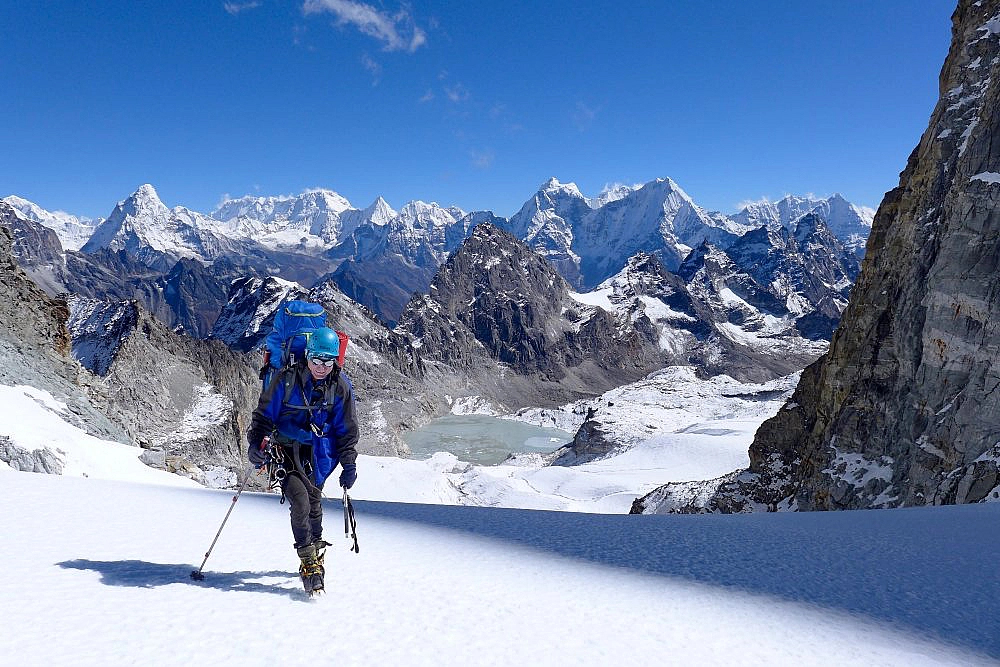
The rucksack recommended by Jagged Globe for this trip is the Lowe Alpine Metanoia, with a capacity of 60-80L. Pretty much the minimum you can get away with is a 60L sack – and you will nearly fill it twice on those two carries to camp 1. And you’ll definitely fill it on the descent after summiting.
Carrying personal gear to the camps is very different from most trips and we all felt the loads. The first carry was up and down to/from camp 1 to stock it with essential technical climbing gear. The second carry is from base camp, to camp 1 again, stay the night and then a carry from camp 1 to high camp on the col. (Whilst this is a physical challenge for everyone, at altitude, let’s not forget though that the climbing sherpas take the tents, stoves and rope!)
Our night at high camp wasn’t as cold as it can be. After an 0345 alarm for an 0500 getaway we roped up the short snow slope onto the rockband. I’ve seen this described as “Severe” climbing standard, but it’s probably more like “Diff”. It’s on the fixed ropes put up by the climbing sherpas, but still not to be sniffed at in big boots and crampons, by headtorch and wearing mitts or the thickest of gloves.
After that we were onto the snow slopes. These were hard and icy. When our sirdar Pema had met his mates on our circumnavigation of the Kyajo Ri, they had told him they thought we didn’t stand much chance of summiting because of the hard climbing conditions this year. Credit to our team – sherpas and climbers – that we did. Our team slowly strung out as we climbed at different paces, but staying in good contact with each other, Ankit, Carl, Hannah, Mark and Mike all reached the top, where we saw footprints on the ridge coming from the north face (well done the Russian team) and then, after photos, began our abseil descent.
After drinks and soup at high camp we descended to camp 1, slowly and carrying big loads. Then a night at camp 1 saw us emerging slowly next morning for a descent to base camp carrying even bigger loads, but with huge satisfaction that we’d done it. We’re told that we were the fourth team to try the route this year, but the first to summit. Jagged Globe’s third exped to the mountain – and its third success.
We had a surprise remaining. We hadn’t used our spare climbing day and there was a possibility we’d have to spend an extra day at base camp awaiting the arrival of the yaks to transport our gear back to Namche. Lying in our tents on the first night back we heard yak bells as they arrived at 10.45 pm. They had set off in the dark from Samde and ascended the rough and exposed terrain to get to us in time for a descent a day early. Is there nothing that the Nepalese and yaks can not do?
And so, a satisfied amble to Namche, then on to Lukla for party and cake and then a hastily revised day-early return to Kathmandhu for relaxing, shopping, eating and few beers. Thanks to Pema and his team, especially Mingma, Kilu and superb cook Mani. Thanks to Ankit, Carl, Deborah, Hannah, Mark and Mike for a memorable trip.
If you fancy a challenge in the Himalay that takes you beyond the trekking peak experience, this could be the one for you – but you may need a new, lightweight, expedition rucksack.
Tony Halliwell, Expedition leader
« Previous report | Next report »
Categories
- Announcements (0)
- Blogs (0)
- News (0)
- Trip Reports (0)
- Articles (0)
Archives
- April 2026
- March 2026
- February 2026
- January 2026
- December 2025
- November 2025
- October 2025
- September 2025
- August 2025
- July 2025
- June 2025
- May 2025


