
Kyajo Ri 2015
Written by Leader Matt Parkes, January 2016
Well... part of my agreement in leading a trip for Jagged Globe is that I write a web report. Quite rightfully so, after all I, the team, have just experienced a great adventure. We need to tell the world and those hoping to follow in our footsteps the journey that we have been on!
I have been on many Jagged Globe Expeditions over the last 10 years and this has to be one of the best, if not possibly one of the most challenging due to events that will become clear as you continue to read this report.
When you embark on an expedition as a leader many things go through your mind. Have I read my briefing notes, have I packed everything, I need to remember everyone's names from the list, who is meeting who at the airport... the list goes on. As a leader all you want from an expedition in a remote and challenging environment, is that you meet a team of people that embrace the sense of adventure. This means taking things in your stride, being a team, supporting each other, not being phased when things donít go as planned.... again, the list goes on. When I met the team at Heathrow and later in Kathmandu, I had my hopes up for a great team that could work together and hopefully achieve our aim of climbing Kyajo Ri.... I met a great team ready for a challenge.
Arriving, we saw Nepal struggling with a fuel shortage, the roads were unusually quiet. The trip to the hotel took 20min instead of the usual 45min to 1.5hrs. After a briefing and some finalising of the usual arrangements we all went to bed, ready for the usual early 5am departure to Lukla airport. A few hours wait and the familiar chaos saw us on a flight to Lukla. Before you climb a mountain in Nepal you need to acclimatise and this is the key to unlocking the summit. Following the Kyajo Ri itinerary you have a great acclimatisation process. Walking to Namche, onto Gokyo, over the Renjo La high pass and then returning round to Mende before tackling wild country to reach base camp.
You follow the Everest trail for the initial part of the expedition before breaking off towards Gokyo. This is a privilege in itself, suddenly the trail goes quiet and becomes narrower with each footstep. Eventually reaching Gokyo, the team was to tackle its first major challenge of the expedition, climbing Gokyo Ri. We set off early in the morning and made the summit in good time, enjoying the emerald skies reflecting on the south face of Cho Oyu. Everyone did well but found it challenging! The following morning saw us ready for a climb over the Renjo La pass. At over 5000m it is quite an obstacle. With everyone in good form and excellent weather we set off as a team. Everything was going well, if not challenging given the altitude. Enjoying the views and the challenge the we took a rest in a nice spot, a good place to catch our breath and survey the last section before reaching the highest point on the pass. At this stage some team members were going a bit slower than I expected, some a little quicker. Not unusual for a group of twelve people, you have good and bad days at altitude, we pressed on and I felt happy with the team's performance. Prior to reaching the summit you cross a rising open space, before tackling the last part of the rocky walk to reach the top. It was at this stage that I had noticed one team member, Annie, drop back a fair distance from the rest of the team. Annie was being assisted by Pema, tasked with the job of looking after the rear end of the party. Not immediately concerned I stayed to keep an eye on Annie and let the rest of the team carry on with the Sherpa team to the top.
Having watched Annie and Pema for a short while I became a little more concerned, given that Annie was often much quicker on previous parts of the walk in. At that moment Pema started to signal me to walk down to them. On my arrival I found Annie to be her usual enthusiastic self but explaining to me that she was finding this very hard and concerned that something may be wrong. We walked another 10 or so paces so I could see what Annie was experiencing, it became clear to me that it was not wise for her to proceed to the top of the pass. Annie was describing symptoms of fatigue and some tightness in the chest. I now knew that I had to make some tough decisions, with Annieís safety and the rest of the team being a priority. Pema and I discussed options, I decided that Annie and I would walk back down to Gokyo. From there we could access medical help if necessary and arrange evacuation. Pema would go on, inform the team and send a Sherpa to catch us up on descent to Gokyo with our bags and extra oxygen. Pema shot off up the hill and disappeared into the distance as we set off down. 15 minutes passed and Annie stopped for a rest on a rock, pulling out her iPad to take a picture of Everest in the distance. The events that followed certainly tested me as a person and an expedition leader. Annie suffered a sudden major cardiac incident, I realised she had stopped breathing and had no pulse. I had immediately started CPR and miraculously Annie started to show signs of life. It is hard to go into such detail in the trip report but what followed was a 4 hour ordeal of trying to keep Annie alive and co-ordinate a rescue by helicopter from the Renjo La Pass. If you would like to read more about this Annie has covered her side of the events in her excellent blog.
With no medical support on the helicopter I flew out with Annie to eventually arrive in Kathmandu. Relieved that she was now in safe hands I retreated for reflection at the Summit Hotel. The following morning I got back on a Lukla flight and spent the next few days walking back up the hill to eventually meet the team in Mende. A busy few days....!
Time to focus on the mountain and reunited with the team, the hope was to leave Mende the following morning and tackle the tough terrain into BC. We awoke that morning to a heavy snow storm, not good! The Kyajo Ri base camp is situated in a remote hanging valley. You have to cross some rough mountainous terrain to reach camp and the idea of being stranded there in heavy snow was not appealing, so we decided to hold out another day in Mende and wait out the weather.
The following morning the weather seemed to be clearing and despite some heavy snowfall we packed and left for camp. The route crosses an impressive mountainside and follows a single faint track, which from a distance looks almost impossible to pass. What is even more impressive is watching the yaks follow, without them the team would struggle to get supplies and equipment into camp in such a timeframe. On arrival at BC the tents were struck and the kitchen set, this is a quick and efficient process thanks to the skill of our local support team.
With everything in place it was time to decide on a plan of attack. We had already lost a day due to the weather and we were still faced with breaking trail through the snow to reach the upper camps and hopefully climb Kyajo Ri. After much discussion with our experienced Sherpa team, I decided to split the group into 2 teams, climbing on consecutive days. This is can be a difficult thing to do as often, as in our case, it was not a clear split. Looking at the weather reports our window was closing even more as high winds were approaching. I was reasonably confident that we would have two satisfactory days to mount our ascent before 80km/h winds hit the slopes of Kyajo Ri. Splitting the team also meant that we could take 50% less equipment to the top and the Sherpa team could fix the route quicker, just in time for our summit window. Things were looking a little tight, but you can't plan the weather!
Early the next morning the Sherpa team and some of our cook team set off to load carry for camp 1. The rest of us took advantage of a rest day in camp to prepare equipment and do a refresher session on ascent / descent of fixed lines. The slopes of Kyajo Ri are steep and often icy, so good safe technique is a priority. That evening the Sherpa team returned to camp and prepared for the following day. The next morning the Sherpa team set off for another big day and Team 1 departed for the first day of load carrying up to camp 1. I think that it's fair to say that the load carrying is one of the hardest challenges that you face in climbing Kyajo Ri. The route climbs up the valley to a huge wall that looks completely impenetrable from a distance. As you get closer you can see that a couloir strewn with boulders allows you access into another hanging valley above. This is a challenge in itself, but it is even more of a challenge when the rocks are covered with snow. Having climbed into the valley above BC, you then enjoy a long but winding walk next to a river. Just before you think it's all over you are then faced with another steep climb up scree to eventually reach C1. Some team members found this very difficult and I could see some signs of concern over the challenges that still remained.
The next day would usually see the team having a rest at C1, but with the approaching high winds Team 1 would continue to C2 and Team 2 would tackle the load carry to C1. The climb to C2 is no easier and follows similar terrain as the previous day. You leave camp and cross a frozen lake to reach the foot of a glacier. From here it's an icy crossing avoiding the odd crevasse until you reach the final climb through a rock step. Fixed ropes were used to protect this section. This is again another tough day, but as you reach the col you are rewarded with fantastic views into Tibet on one side and Nepal on the other. Separating these views is Kyajo Ri and the face that you are to climb in order to gain the summit ridge. A very tired team made it to camp 2 whilst the second team reached camp 1 with Pema, our Sirdar. Thankfully, whilst all of the team members were tackling the carry to relative camps, Kilu and Pema Sherpa had managed to find and fix most of the route to the summit. We were to fix the last sections ahead of the first team on summit day.
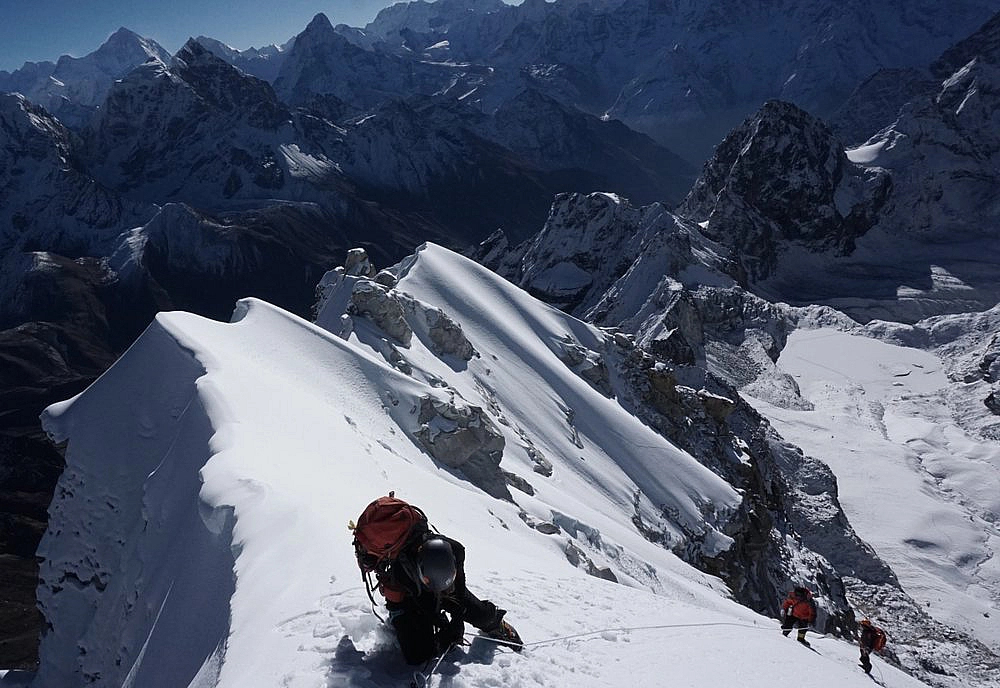
Both teams went to bed tired after an evening meal of soup and freeze dry bag food. I went to bed hoping that the high winds did not emerge any quicker than suggested on the reports. We awoke the next morning to perfect climbing weather, clear and no wind whatsoever. The first team set off to tackle the climb. It,s a great route that is always interesting and not too long, which is good given the load carries up and down the mountain. The fixed lines start pretty much as soon as you leave the top camp. After a short snow slope you hit the rock band, one of the most interesting sections on the route. Mixed climbing on rock and ice, the easiest line takes you across slabs and up narrow gullies. Good crampon techniques and reading the rock will definitely save important energy for the route that lies ahead! At this stage the sun had began to rise, surrounding us in an emerald glow. Emerging from the rock band you meet the icy slopes that need to be negotiated to unlock the summit ridge. Conditions were good, the fresh snow had consolidated on the slopes making the climb upwards easier for most of the way. The first team made good progress, moving steadily in pairs up the fixed lines. After 4 hours of climbing the first pair reached the top in now warm and sunny weather. The final section of the climb sees you hit the ridge and slowly make your way to the sharp summit. A great finale to a very enjoyable climb! The last team member reached the summit and by now the first pairs were busy abseiling back down the route. A short break for refreshments and packing as Team 1 prepared to descend to camp 1, just as the second team emerged at the top camp. Pema and I swapped groups and I readied myself for a second ascent the following morning with the second half of the group. Again I went to bed hoping for another great day.
Another early start but this time the tents were being battered by high winds. I lay there listening and feeling pretty disappointed. I knew immediately that the wind was too strong to attempt an ascent. I got up, dressed and ventured outside to get a feel for what was going on. Not wanting to give up I postponed the start time by one hour. I think a few people looked at me in disbelief, feeling their summit attempt slipping away. I retreated back to the tent listening and willing the wind to calm. The hour came and we got lucky, as if someone just flicked a switch, the winds died completely. The second attempt was underway! The second team followed the same route up the mountain in warm, sunny and calm weather.... perfect! Everyone made it to the top in good form and then retreated, tired but happy, back to camp 2 and then on to camp 1.
A final tough load carry saw the team reunited in BC for a well-deserved rest. The following day we made the decision to head off back down the valley to warmer weather and a well-deserved beer or several.
Making our way back to Lukla we eventually caught the flight back to Kathmandu and were soon enjoying the relaxing atmosphere back at the Summit Hotel. On our return it was great to see Annie again, who having had 2 stent operations, was out of hospital and making an amazing recovery!
Thanks to our Sherpa team and local staff who worked incredibly hard to make the trip run to such a high standard.
Thanks to the group who embraced the spirit of adventure, supported each other and made this expedition such great fun!
« Previous report | Next report »
Categories
- Announcements (0)
- Blogs (0)
- News (0)
- Trip Reports (0)
- Articles (0)
Archives
- April 2026
- March 2026
- February 2026
- January 2026
- December 2025
- November 2025
- October 2025
- September 2025
- August 2025
- July 2025
- June 2025
- May 2025


