
Elbrus - 15 Jul to 27 Jul '17
Written by Leader Olan Parkinson, August 2017
Our lives seem to be full of tick lists, especially when it comes to adventures in the outdoors. From ten tors, long distance walks, city marathons, through to collecting mountains, the Munros, alpines 4000ers, on to 5000m 6000m and upwards. The 14 8000ers are of course considered to be the ultimate in extreme mountaineering tick lists, closely followed by the Seven Summits.
The literal pinnacle of the seven summits, as most will know is Mount Everest. At 8,848m and given the technical difficulties it would seem that this should be off limits to most budding mountaineers. With Everest and other attractive mountains such as Denali or Vinson on the radar of the potential 7Summit club member, surely the roof of Europe, Mount Elbrus is simply one to just tick off; after all it is a short trip, relatively speaking, There and back in a little less than 2 weeks, it is ‘only’ 5462m, not even as high as Kilimanjaro, and that was not too difficult… Well if that is the way you are thinking you might want to think again. Elbrus is hard, very hard.
We had a slightly fragmented start to our trip meeting team members at the various airports on the way to Pyatigorsk which is the staging post for the trip to Elbrus. But with a late arrival by one team member the team was complete and everyone was set to depart for base camp. The drive to base camp is pleasant despite the fact that our bus seemed to really struggle with anything other than a flat road. It meant a slightly longer walk to base camp but the weather was good and it all aids acclimatization. Two and a half hours saw us to base camp, and within the hour the team were in their huts. Shortly after, the volleyball net, having received some remedial treatment, became the focal point for some multi-national competition (at 2450m) to work up a proper appetite before dinner. Again, all excellent acclimatization.
The next two days were to be given over to improving our acclimatization; the first day a 5 hour round trip to Mushroom Rocks with good views of the twin Elbrus summits, the next day we would move up to the high huts at 3,700m to begin our preparation for progressing up the mountain.
Unless you have done Elbrus, as I have alluded to, it is quite easy to think of it as a peak that should not be too difficult. For many, it will be their first time over 5000m. At base camp 2,450m you will probably be feeling quite well and the temptation to do too much too quickly is quite strong. But altitude and more specifically AMS is indifferent to your enthusiasm. Slowly is the name of the game. The walk to Mushroom Rocks is not overly taxing, it is only just over 3000m but it is a necessary step in the ascent profile as the day after you walk to and stay at just over 3,700m. Pushing yourself too much the day before will only make the efforts to acclimatize the next day even more difficult, and at this altitude you are already operating at a deficit.
Within 48 hours of being at the high camp, two team members were feeling the effects of the ascent. Loss of appetite, headaches, and vomiting. All symptoms of AMS. At this stage there is not much you can do except rest, stay hydrated and wait it out.
Day 2 of our acclimatization saw most of us reach 4,800m with a couple reaching 4,600m. This was a great effort all around considering only a few days before we were playing volleyball at 2,450m. Our tentative plan was to attempt the summit that night but the weather forecast was for thunderstorms and strong winds, so it was looking like we were going to have to use our spare summit day. I got up at 11pm to chat with our guides Alexandr and Konstantine, the clouds were down at hut level and we could see the lightning reflecting on the clouds around the high camp, dramatic and exciting but not conducive to a summit attempt. I stuck my head into the huts to let the team know, none of them had stirred anyway. We had to wait.
The next morning was grey and the snow lay around the camp but the winds had dropped so we decided to head onto the glacier and throw ourselves about a bit and practice some skills. The weather continued to settle, the winds dropped and by midnight the skies were clear. This was our shot. At 1am, head torches flicking about the glacier we set out. The slopes above us lit up by the various people-trains of summit hopefuls all moving on a collision course, admittedly a very slow collision course headed for the lower sections of Lenz Rocks at 4,600m.
On reaching the hollowed out pinnacle at Lenz rocks the winds decided to make their presence felt. About 30 people were crammed in trying to sort out extra layers, goggles against the driven snow, and all the while trying to keep the different ropes from getting tangled. The winds made the mood a mix of apprehensive and excited. The sun was coming up which always brings a certain amount of relief, although up here the cold was beginning to creep in. It does not take long once you have stopped. For me this felt no different to being at 6000m on Mera Peak or similar in Nepal. This is a full-on climb. We had reached 4600m, with a further 1000m to go!
The next 4 hours seemed to drag. As I have read on other reports, the traverse from Lenz Rocks to the col seems interminable. The sun came up, of course, but it did not feel any warmer. The winds did not seem to drop, but we plodded on. Radio conversations between the teams to make sure everyone was ok were the only communication…other than that it was head buried in hats or hoods, googles on, existing in that weird fish bowl, colouring the snow orange or green, confining you to your thoughts, until a stumble by someone on the rope drags you back to reality. My rope team and Alex’s were making similar progress. We climbed to the col and stopped for a break. A short radio communication let me know that one of Konstantine’s clients was struggling. I agreed to go down and check on Konstantine’s team, with a view to possibly descending if necessary. The rest of the team were feeling really strong and moving well so I wanted them to keep moving, and not jeopardize their chances.
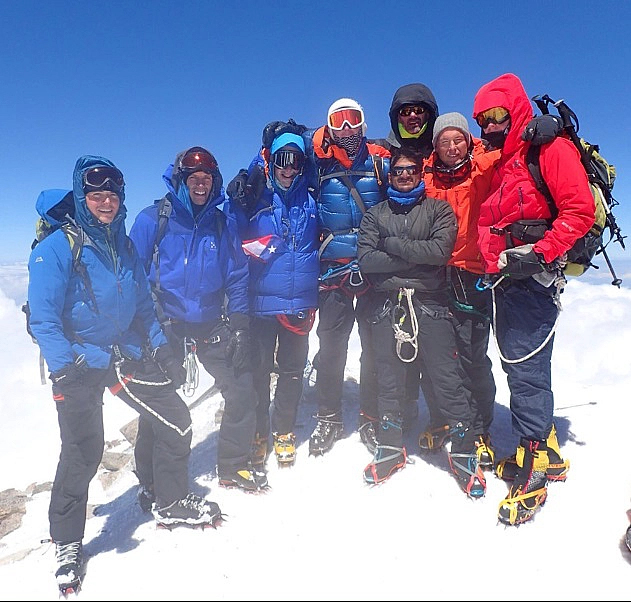
On reaching the other clients it was immediately obvious that one needed to go down, I tied my client onto a short rope and started to descend. While this was happening the rest of the team were making steady progress towards the summit. The winds had not stopped although the skies stayed clear. It was down jackets and goggles all the way. An hour and a half up the summit slopes. A further hour crossing each of the false summits, painfully along the fixed ropes traversing the glassy final icy sections until, deservedly, reaching the roof of Europe! The team had made a strong ascent and they summited around 1pm, just after A, a little worse for wear but still smiling, got back to the huts at high camp.
Congratulations to the entire team for a strong collective effort. A thoroughly deserved summit. Thanks to our Russian Guides Alexandr and Konstantine and the great cook staff at the high camp. Thanks to Jagged Globe for the support and opportunity. Always a pleasure.
« Previous report | Next report »
Categories
- Announcements (0)
- Blogs (0)
- News (0)
- Trip Reports (0)
- Articles (0)
Archives
- April 2026
- March 2026
- February 2026
- January 2026
- December 2025
- November 2025
- October 2025
- September 2025
- August 2025
- July 2025
- June 2025
- May 2025


