
Antarctic Climber - 26 February to 15 March 2001
Written by Leader, May 2001
The 2000-2001 Antarctic climbing season was relatively quiet, at least in terms of first ascents and new routes. Suprisingly, Dronning Maud Land saw two groups active, making some first ascents and repeating a number of established routes, reported elsewhere below. In the Sentinel Range the only pioneering activity was that done by the NOVA group on the east side of Vinson Massif (see below), though 65 people reached the summit of Vinson Massif by the normal route. This was the largest number that had ever summited in one season and represents the traditionally very high success rate on this popular route, given that 70 climbers attempted the ascent.
The popular Antarctic Peninsula saw significantly fewer climbing teams than recent years. First off for the season was the Spanish team of Iosu Feijoo, Oskar Palacios and Jose Antonio Estivariz. This group arrived at the Chilean Gonzalez-Videla Base, situated at the northern end of Paradise Harbour. Aided by base personnel, who ferried the team to the base of their climbs with a Zodiac, the Spanish climbed a 318m peak on December 19th, named by them 'New Euskadi Peak' and a 581m peak on December 24th, which they called 'Gasteiz-Araba Peak'. Given the locations of these peaks, south of the base, there are no previously recorded ascents and the base personnel from Gonzalez-Videla confirmed to the team that the climbs were first ascents.
In late February, Australian mountaineer Greg Mortimer once again led a commercial cruise to the region which made some minor ascents, operating from the ship 'Professor Molchanov'. A large party from the group climbed the small peak known as 'Mt. Don Roberts' on the eastern end of Lemaire Island. More significant was the first known ascent of the eastern peak of Two Hummock Island. Around 670m high and with a challenging corniced section near the summit, the smaller team that made the ascent gave the peak their unofficial name of 'Roald Peak', after celebrated Norwegian explorer Roald Amundsen.
During the first two weeks of March the well-known Antarctic commercial operator Adventure Network International (ANI) ran a commercial climbing cruise using the Dutch-owned 'Grigory Mikheev'. Aboard were three climbing groups - one group of six clients from the UK plus the three ANI guides - Rob Hart, Damien Gildea and Ben Marshall, one independent, international, non-guided group - Ronald Naar (Netherlands), Vicente Castro Sotos (Spain), Javier Selva Serrano (Spain) - and another independent group of snowboard-mountaineers, led by Doug Stoup on his second visit to the region. The latter group's activities are reported elsewhere below. Both Stoup and Gildea had, only one month earlier, stood at the South Pole, after guiding a two month, 1100km ski traverse from the coast.
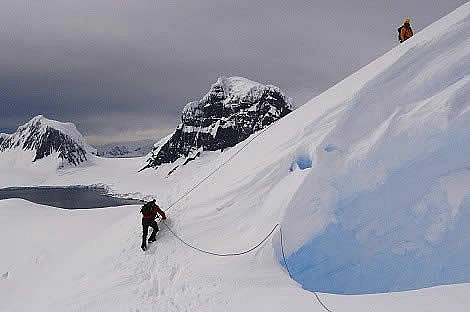
On March 3rd both the guided group and the international group made an ascent of a minor 550m peak on the western side of Andvoord Bay. The climb was a straightforward snow route with some minor crevassing. March 4th saw both groups again climbing together, but attempting the first ascent of the striking rock peak of Mt. Tennant (690m), situated on the northern end of Ronge Island. The group accessed a less difficult snow and ice route on the south-east side of the mountain but at mid-height the route was deemed unsuitable for the larger guided team due to hard-ice conditions and the nature of the upper ridge at this time of year. Naar, Sotos and Serrano continued, reaching the summit some hours later to complete the first ascent. Overnight the ship moved south to the Waterboat Point area, where, on March 5th the group pursued a number of objectives. Two clients and one guide, as well as the international team and Stoup's team, made an ascent of the obvious small peak above, and to the west, of the Chilean base Gonzalez-Videla. This peak, really a low, satellite point of Mt. Hoegh (890m) was a relatively straightforward climb, with some crevassing down low, a thin band of very loose rock and some steeper terrain toward the summit. At the same time, the rest of the guided group climbed the easy-angled ridge on the eastern extremity of Lemaire Island that includes the small summit known as 'Mt. Don Roberts', as well as a slightly higher peak. The group climbed both peaks but did not attempt to continue to the higher, more challenging peak beyond.
The international team and the guided team both climbed together on March 6th on an attempt of the popular peak Mt. Scott (880m), situated prominently at the southern end of Lemaire Channel. Due to the almost perfect weather experienced throughout the season the glaciers were thankfully free of deep snow, but these same conditions produced broken ridges and significant crevassing, not only low down on the glaciers but also high up on summit ridges. Such conditions turned the group back on this occasion, high on the upper reaches of Mt. Scott's normal west ridge route. They then turned toward the east and ascended the highest point of the horseshoe-shaped massif, an easy snow summit of around 980m that gives spectacular views over the area and down into the beautiful Lemaire Channel. No name was suggested for this summit, as although no previous ascent has been recorded, it had probably been climbed before. March 7th the entire group rested, photographed the abundant wildlife and enjoyed the hospitality of the Ukrainian personnel at Vernadskiy base.
On March 8th, fuelled by the previous day's home-made vodka, the guided and international group set out on a two day attempt on Mt. Shackleton (1465m). After easily accessing the snout of the Wiggins Glacier, south of the peak, the group proceeded up the Wiggins, hauling sleds and establishing a camp toward the head of the valley, below an obvious icefall. Travel on the Wiggins was good except for numerous large crevasses and the heat of the beautiful weather. Starting early on the 9th the two teams took separate routes through the jumble of blocks and seracs above to reach the base of the west ridge, the normal route on Mt. Shackleton. After ascending and traversing numerous short steep and icy snow slopes the group was halted at around 1100m beneath an impassable bergschrund. Passage on either side looked unlikely so the larger guided group was forced to retreat once more. Naar, Sotos and Serrano persevered however, climbing some steep ice with little protection in a minor north-side variant to the usually straightforward west ridge, reaching the summit around midday. This was probably the first non-government ascent of this beautiful peak. Upon seeing the three safely descending, the guided team broke camp and moved back down the Wiggins in continued perfect weather. All were reunited onboard the Grigory Mikheev by dusk.
March 10th, the last full climbing day and the team once again split for various activities. Naar, Sotos and Serrano climbed up to a point on the very corniced ridge south of the spectacular Mt. William (1600m) on Anvers Island. Three clients and two guides went to the twin summits of Jabet Peak (545m), the shapely little mountain on Wiencke Island, right next to the Port Lockroy base. The rest of the group spent the day toproping vertical ice on a nearby glacial edge. That evening the ship left the area, giving the group spectacular views of the gargantuan Mt. Francais (2822m), the highest mountain on Anvers Island, before heading north, visiting the wildlife of Deception Island on March 11th, then arriving back in the port of Ushuaia in the early hours of March 14th.
Leaving the mainland, probably the most significant ascent of the season for the whole Antarctic region was the first ascent of Mt. Roots on South Georgia, reported below. Attempted more than five times by strong teams over more than 25 years, Mt. Roots had been the highest unclimbed mountain on the island.
Unreported from the previous season was the Swiss "Antarctique 2000" expedition to Wiencke Island. Travelling aboard the yacht 'Philos', skippered by Eric Barde, Laure Schmied, Eric Christinet, Michael Hiltebrand, Paul Kobler and leader Francois Germain journeyed to the Port Lockroy area and established a base camp below the well-known Savoia Peak (1415m) on February 10th. They then attempted a probably virgin peak between Savoia Peak and Janssen Peak (1085m). After climbing to a point above 700m on this peak the team was reportedly turned back by unstable ice walls, poor snow conditions and unseasonably warm temperatures. They then turned to a lower peak, north-east of Savoia Peak and climbed it, finding it to be around 730m in altitude and giving it the name 'Mont PiaBer'. After spending another two days and nights at their basecamp in a severe storm the team returned to the Philos, then sailed to the Chilean base Gonzalez-Videla for some scuba diving on February 15th. The Melchior Islands were visited on the way home, Puerto Williams reached on February 23rd, Ushuaia on the 24th.
Damien Gildea
May 5th 2001« Previous report | Next report »
Categories
- Announcements (0)
- Blogs (0)
- News (0)
- Trip Reports (0)
- Articles (0)
Archives
- April 2026
- March 2026
- February 2026
- January 2026
- December 2025
- November 2025
- October 2025
- September 2025
- August 2025
- July 2025
- June 2025
- May 2025


