
Himlung Himal 2025 report
Written by Leader Olan Parkinson, November 2025
After fourteen years of expeditions, you’d think I’d have the packing sorted. No lists, no dithering — just lay everything out and get on with it. At least that’s the idea. In reality, I caught myself stuffing gear into the Jagged Globe duffle almost on autopilot, only to empty it all out again to check what I’d actually packed. So maybe not quite as dialled as I’d like to believe.
Packing always drags my mood down anyway. It’s not the physical hardship ahead — that’s the attraction — it’s the prospect of being away for a month, constantly around people when I’m not the most outwardly sociable person. Most groups I’ve led could probably tell you that. Still, I boarded the train to Heathrow with the usual mix of resignation and anticipation, travelling alone for the first time in years. No clients to shepherd through the airport, just me and whatever was circling around my head.
A lot of that was memories from 2012, when I first led a personal trip to Himlung. Nar Phu had only just reopened then, and we were the first UK team to go in. We climbed Karma Himal on the way, pushed toward Himlung, and ultimately got shut down by weather and time. But we learned a lot — self-led, lightly supported, and figuring things out because no one else was going to. All of that coloured the start of this trip.
Qatar Airways delivered me into the chaos of Tribhuvan International, where I found Jagged Globe’s Ed C. waiting on bags. Soon we were out in Kathmandu traffic, winding through the last days of the Dashain festival — coloured lights everywhere, but also the charred shells of hotels burned during the recent protests. Celebration on one side, violence and anger still fresh on the other. It was hard not to notice the contrast.
At Hotel Thrive, Shiv was waiting, as dependable and welcoming as ever. We met our Sirdar, Mane — calm, measured, and clearly ready for his first trip leading from the front after years working under Pem Chiri. I had a good feeling about him immediately.
The team looked strong given their experience: all with 6000-metre summits, all seemingly solid. You always hope for a group like that — the sort that almost doesn’t need leading. We had our introductory dinner, Liz arrived in time, and we were set to leave Kathmandu in heavy monsoon leftovers.
We made fifteen minutes of progress before turning around. Landslides had closed the road. Another night at the hotel. The next morning, the road was clear enough and we crawled to Besisahar in typical Nepali fashion.
Besisahar has grown since I last passed through. The Gateway Himalaya Resort made an ideal staging post — comfortable rooms, big spaces, even a pool, with the foothills rising behind it and the white summits beyond. From here, jeeps took us to Koto on the newly widened road cut into the gorge by the Chinese hydro project. Safer now, but still slow.
Koto brought our first real setback. Rick, nursing a back injury, made the wise decision not to continue. Liz, also having back trouble, realised this was as far as she could go. It’s never easy to see people turn around so early, but it takes honesty and strength to make that call. We said goodbye to a quarter of the team before we’d really begun.
From Koto to Phu, everything changes. The crowds of the Annapurna Circuit disappear. The valley tightens. The sound of traffic fades until it’s just wind and river. Himlung may be more climbed these days, but it’s hardly busy. Most hours on the trail were spent in quiet, climbing steadily up the gorge until the land dried out and the air thinned into the hidden bowl of Phu. Thirteen years on, the place looked much the same to me. A tight nest of stone houses stacked into the hillside, still isolated, still somehow untouched. Our lodge was across the river — the last real bed we’d see for a while.
Two days of acclimatisation came and went, then we made our way to base camp at 4,800 metres. Himlung, Himjung, and Nemjung revealed themselves one by one — wind tearing long banners off the summit ridge. The new base camp sits opposite the old 2012 one, which meant I had a clear view of the route we’d climbed back then. Glaciers shift, but even so, I could see now why the line has changed. What felt like adventure back then looks suspiciously complicated with hindsight. Probably for the best that we didn’t know.
We settled into camp — our cluster of tents perched at the top of the sprawling site — and fell into the rhythm of altitude: short walks, rope practice, long afternoons in the mess tent, letting the mind catch up with where the body now lived. The team looked good. Skills were solid. Spirits were steady.
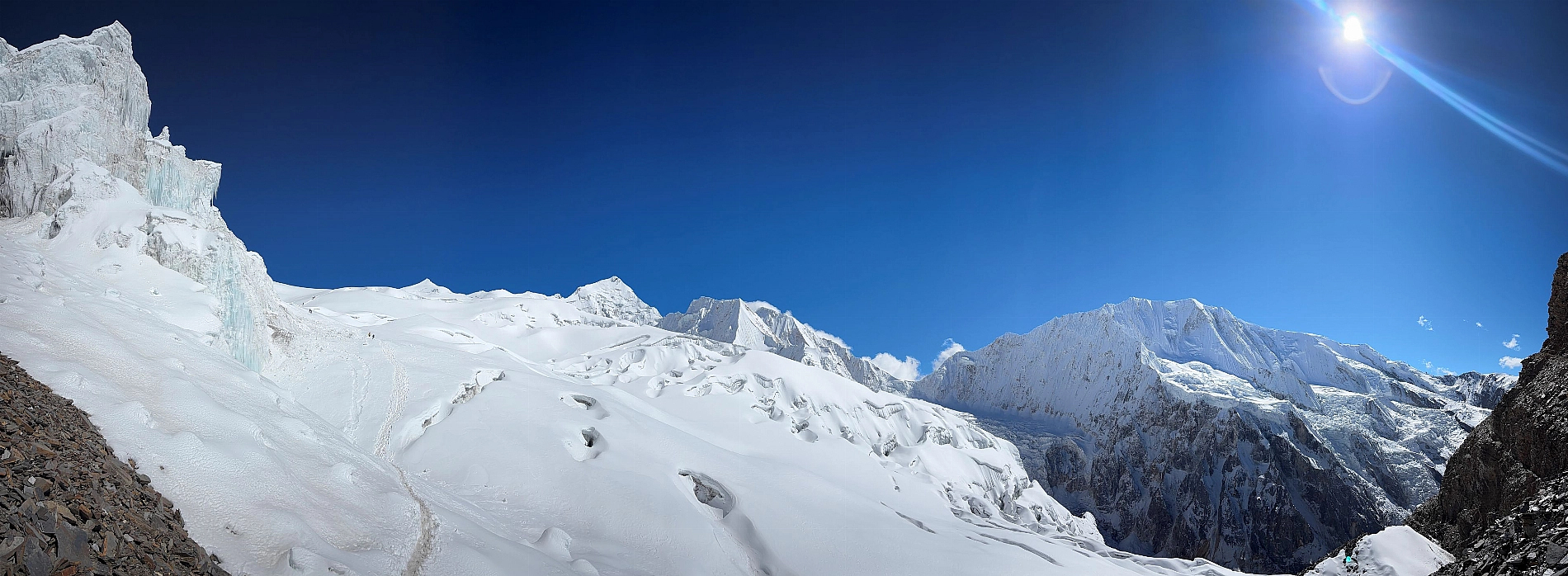
Soon enough we were pushing toward Camp 1 over the dry glacier, with Kim and Liana recognising the terrain from their previous attempt — not fondly. But conditions were decent, and after a couple of hours we climbed out of the moraine and up into the hanging valley. Camp 1 sits tucked away, out of sight of the upper mountain.
From there, we climbed toward Camp 2 on the long ridge — part rock, part snow, all thin air. The NMA team had fixed ropes early this year, and we climbed to around 5,800 metres to shake things out. A hard day, nearly a vertical kilometre above base camp. Illness and fatigue caught up with some, and a couple turned back. Sensible decisions all around; everyone knows their own body.
The next day, we made the move toward Camp 2 proper. High-altitude recovery is never guaranteed, and yesterday’s strength doesn’t always translate into today’s. Brian, fighting a stubborn cough, chose to descend — the right call. The terrain above the snowfields steepened into a loose rocky gully and then an exposed traverse, before granting us passage onto the serac-guarded glacier. Fresh debris reminded us exactly what those seracs can do. No one lingered long.
Camp 2 sits around 6,000 metres, an improbable little cluster of tents on a ledge guarded by giants. The Sherpas were already waiting with juice and noodles — welcome luxuries at that height. We spent a long, cold night listening to the wind and waiting for the sun to thaw the frost off the tents.
Back at base camp, with everyone reunited, the forecast became the centre of attention. The summit window looked messy — winds, snowfall, uncertainty — so we pushed things back a day and focused on eating, sleeping, and staying sane. When we moved again, the storm didn’t materialise, and we made good time to Camp 1, then split the next day into two groups to climb up to Camp 2. Everyone climbed at their own pace; the only sensible way to approach altitude.
Another long, restless night at 6,000 metres followed. Then came the push to Camp 3 at approx 6,300m. Matt didn’t feel he had the reserves to continue and made the tough but correct choice to descend. The rest of us climbed steadily toward the final 250-metre wall — a steep, fixed-rope haul at 6,000-plus metres that tested everyone. Mathew and Mandy reached Camp 3 ahead of us; Kim and Liana arrived with us just as the wind started to rise. By the time we were zipped into the tents, it was howling — loud, persistent, and very reminiscent of 2012.
Sleep was scarce. By 4 a.m., we were all awake, listening to the Sherpas moving quietly outside. Kim and Liana had already decided they were content to descend — they’d climbed higher than on their previous attempt, and the wind was still unforgiving. Mathew and Mandy wanted to wait until 7 a.m. to see if conditions softened. The wind eased slightly but never enough to justify a summit day. Watching other teams set off is always hard, but experience, not ego, has the final say. Everyone chose correctly.
The descent was long, hot, and taxing. Fatigue, altitude, sun glare, poor sleep — all the usual traps. The couloir demanded total focus. The snowfields felt endless. But eventually we reached Camp 1, where Mane and Karne had food waiting for us. After a rest, we pushed down to base camp ahead of a heavy snow forecast, then to Phu the next day. The valley was blanketed in fresh snow by morning. Mane wanted to stay put, but worsening forecasts pushed us onward; the walk to Meta ended up being strangely enjoyable despite tired legs.
Mane went ahead to secure a jeep from Koto — difficult, as vehicles were ferrying people out of Manang to get ahead of the storm — but he managed. We reached Kathmandu a day early, tired, safe, and satisfied.
So, was it a successful trip?
Mane put it simply: if everyone gets home to their families, healthy and with all fingers intact, that’s success. And I agree. A summit would have been welcome, of course, but summits are optional. Good decision-making isn’t. Throughout the expedition, people made hard choices for the right reasons — experience, safety, honesty with themselves. That deserves respect.
In the end, a retreat made through sound judgement is not a failure. It’s the sum of everything you’ve learned until that moment. And if you trust that, you can’t be disappointed by choosing to come down.
Thanks to the team for being flexible, adaptive and maintaining a sense of humour throughout. That’s the real success. Thanks to Shiv and our local team, without you guys these trips would never happen. As always thanks to Jagged Globe for the opportunity and support.
Himlung Himal Team 2025
Mathew H – Camp 3
Amanda R – Camp 3
Elizabeth W – Koto
Matt H – Camp 2
Rick B - Besisahar
Brian J – 5,800 m between Camp1/2
Kim M – Camp 3
Liana L – Camp 3
Mane Sherpa – Sirdar
Kancheman – Cook extraordinaire
Karne Sherpa
Pasang (1) Sherpa
Pasang (2) Sherpa
Subass (can’t get enough of base camp) Sherpa
Krishna Sherpa
Dali Sherpa
Adoul Sherpa
« Previous report | Next report »
Categories
- Announcements (0)
- Blogs (0)
- News (0)
- Trip Reports (0)
- Articles (0)
Archives
- April 2026
- March 2026
- February 2026
- January 2026
- December 2025
- November 2025
- October 2025
- September 2025
- August 2025
- July 2025
- June 2025
- May 2025


