
Cho Oyu 2007
Written by Leader Neal Short, October 2007
After various flights the team of Janet & Keith, Mark, Anselm, James, Janet P and Ian met up in the tranquil surroundings of the Summit Hotel. Before leaving for Tibet we went into Thamel to purchase the odd last minute items (e.g. cycle masks for dusty Tibet) and also head to Shona’s for basecamp down booties (the best around).
The first third of the expedition was a major travel extravaganza. Flying into Lhasa and then taking time to journey along the Friendship Highway across to Cho Oyu BC is designed as an acclimatisation phase, but was an excellent cultural experience in itself. In Lhasa we first visited the Jokhang Monastery which the Lonely Planet Tibet guide accurately describes as ‘hums with activity’ and it was from the roof top that we caught a first glimpse of the great Potala Palace. In the same afternoon we toured the Potala and found it to be a quiet and an unused remnant of a previous time. The palace very nearly made the ‘Seven Wonders of the World' list that was recently announced and it’s easy to spot why. Sitting on top of the 130m high red hill the breadth and height of the palace is extraordinary; and the gold tombs of previous Dalai Lamas are quite staggering (supposedly one tomb is gilded with 3700kg of gold).
After an acclimatisation hike to 4,100m we left Lhasa for Cho Oyu and as the road up until Tingri (close to Cho Oyu) is now tarmaced then a bus was used instead of Landcruisers. Almost immediately out of the city the juxtaposition between super-modern technology and practically medieval type living strikes you. All along the Friendship Highway mobile phone masts have been put up [my phone worked] but at the same time we went past locals getting around using a horse and cart. Our first stop through the Tsang Province was Shigatse (3,900m), Tibet’s second largest town. The highlight is the Tashilhunpo Monastery which after walking around its walls upon arriving, we visited the following day. As a working monastery it provided a good insight to what the Potala Palace must have been like in its hey-day.
Travelling further west and gradually gaining height we reached the Qomolangma Hotel (4,300m) which is just outside Xegar (4,000m). The Hotel was also the overnight stop for many other travel groups and we stayed two nights to aid our acclimatisation process. Here we celebrated Janet R’s birthday.
In Xegar we did one of the best acclimatisation hikes that I’ve ever done by scrambling up the ruins of the Shegar Dzong (4,650m) [see picture on website]. The fort sits on and around an abrupt 600m peak which rises from the foot of the town. We followed the incredible defensive walls which snake towards the summit until half way. Then went out in a clockwise direction on a faint path to reach a col from where we watched monks on the main kora trail, which leads around the whole mountain. At this point the summit of the fort appears beyond reach but a spiralling path can be followed to the top with just a small step to negotiate before reaching the many prayer flags and fantastic vista across the broad valleys below.
The following day was the drive into Cho Oyu Chinese BC (4,900m). After just a short while out of Xegar, we arrived at Tingri and got the first views of our expedition objective. It is actually quite hard to focus solely on Cho Oyu at this point because Everest is on the horizon too. Nevertheless the sight of the big peaks whets the appetite and if truth be known, shocks you out of the relative cosy comfort of ‘just’ travelling. Arriving at CBC was the start of our expedition proper and also the point at which we met up with the sherpa team. It was great to see the guys and for myself, Mark, Keith & Janet renew friendships from previous expeditions with Pasang, Phurba and Mingma. After a few days we set off for the main BC (or ABC) via a night in Interim Camp (5,300m). BC was busy but the sherpa team still managed to find a perfect spot for our camp with running water and good tent platforms. BC affords superb views of Cho Oyu and with binoculars we where able to see other teams moving between camps.
It took a few days to get BC completely organised and on 18th Sept we had our puja. Team member Mark Campbell wrote in an expedition dispatch:
"Today we had our Puja Ceremony with an in-camp Lama who blessed our attempt on the mountain. This was an enjoyable affair which was quite relaxed and casual with loads of chatting and later eating and drinking whilst the Lama continued with his prayers. At the end we all had to eat a bit of tsampa and have it placed on our left shoulder and cheeks all for good luck. Needless to say everyone made a dash for something to wash down the tsampa which gets stuck to your teeth and requires some effort to work loose! As with our journey to BC we continued to use a steady acclimatisation profile. Firstly walking up the Gyabrag Glacier to 6100m and then a couple of days later up to C1 (6400m). Walking up to C1 was our first encounter with the notorious scree slope. Although it wasn’t too bad the first time, it did eventually become a mental as well as physical battle (in the end we climbed the slope 5 times)."
Whilst our first sorties on the mountain where taking place the sherpa team started taking loads (tents, food & gas) up to C1 and then onto C2 (7,100m). The exceptional strength of the guys was astounding and all the members wondered where we would be without them.
We slept up a C1 on the 22 September and then on the 24 September the weather turned for the worst. We were confined to BC for couple of days and then when we did go back on the mountain we nearly got blown off the ridge between C1 and C2 (28 September). At this time a number of other teams started to lose tents and equipment and ultimately this caused the end of their expeditions. It was a sad sight to see other climbers leaving for home without even having had a summit bid.
I wrote at the time for an expedition dispatch [also see photo on website]:
"ABC is experiencing 'Cairngorm' like conditions today and possibly the weather is set to be like this for a further couple of days. The snowfall higher up the mountain is reported to be quite heavy with tales of tents being buried at Camp 3 (7,500m) - we don't have tents at C3 yet. Member’s spirits are still high but are now starting to understand why one part of the expedition mantra is patience. Let's hope we can leave soon for C1 and complete our acclimatisation. One thing is for certain, the chocolate bars and Pringles barrels will take a big hit today."
Mark Campbell also mentioned the poor conditions in his dispatch:
" Unfortunately we heard that one of our tents in Camp 1 has had the flysheet destroyed and Sherpa Mingma has been dispatched to check on the damage. It has the potential to be quite serious as at least 2 members equipment are in the affected tent. Fortunately the damage caused at C1 was slight and no equipment was lost. Our problem was a mini monsoon (that appeared almost without warning) had come up from the Bay of Bengal and didn’t seem to want to budge. Overall we fared better than most teams because not all of our tents where up at C2 and none where pitched at C3. "
During the poor weather the prospect of climbing the mountain wasn’t looking too good. However the forecast on the 30 September (from a Swiss Meteo agency via email) seemed to promise nearly a week of drier air and therefore little or no snow; and crucially winds of only up to 20 knots. Clearly this was our summit chance and although we hadn’t had as much rest at BC as we would have liked we set off for C1 on 1 October. Sadly after the night at C1 Keith decided not to continue and along with his wife Janet, went back to BC.
The walk up to C2 (2 October) was on a particularly cold day and it proved to be quite a tiring day. The main obstacle, the serac at 6,700m wasn’t a problem but the long curving traverse around the top seracs (6,900m) just before camp seemed to go on forever. The following day (3 October) we wore our summit down clothing and the climb up to C3 (7,500m) was a gradual traverse across a steep snow slope. As we where now above surrounding peaks a spectacular vista opened up; down the Gyabrag Glacier towards BC, across to Shishapangma (the only 8,000m peak totally within Tibet) and beyond to barren arid plains of Tibet. Again the sherpas where fantastic by not only helping to carry some of the members kit but also at the same time moving up equipment for C3.
Below is my website dispatch about summit day (4 October).
" Our summit bid started from Camp 3 (7,500m). At C3 the platforms for the tents had been dug into the steep snow slopes just below the striking yellow rock band that crosses the whole face. It was certainly not a place to knock any equipment off the site as otherwise it would quickly disappear into the abyss at a fair rate of knots. After melting snow for drinks and eating as much as possible the team settled down around 8pm for 4hrs rest.
The Jagged Globe office texted the weather forecast to the satellite phone that I was carrying and it thankfully suggested that it would be fine for the following day. However by 11pm the wind had picked up and started to cause some concern [the last thing we wanted was to climb through low night time temperature plus an added wind chill factor]. Luckily the winds did subside and after much effort trying to get ready we left at 2.45pm. Each team member was assigned a sherpa who was to assist them during the climb; James & Anselm went with the ever impressive Pasang; Mark with Phurba; Janet with Dawa and Ian with Mingma.
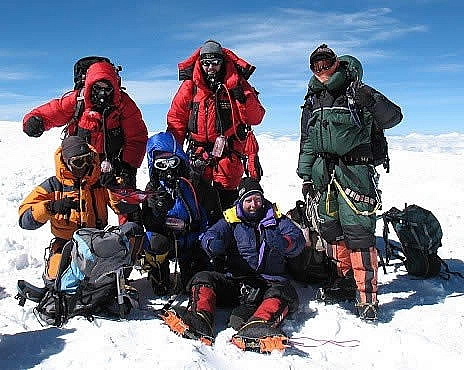
Immediately out of camp the route climbed through the yellow rock band. Everyone found this to be the most exhausting part of the route even though from Camp 3 we where now using supplementary oxygen. As the dawn slowly arrived the views out across the Himalaya became more and more impressive but being only 3 hrs into the climb we couldn't see the mighty Everest which would indicate the summit of Cho Oyu. Gradually the team split into two groups with James and Anselm leading the way [we where able to keep in touch using radios]. The upper slopes of the mountain did not pose any technical difficulty but required steadfast determination to keep on going. The gentle subsidiary rises close to the top were agonising for some members. Then after nearly 7 hrs of climbing Everest rose in the distance [a wonderfully perfect view of the Everest horseshoe]. It was a truly spectacular and emotional indication of success. We all felt immensely privileged to have climbed the 6th highest mountain in the world but in particular this season when the numbers of summiteers where greatly reduced due to the poor weather [some teams didn't even have a summit bid due to losing tents and equipment]. On top we shared the success with the dependable sherpas [who climbed without O2] and a couple of members even managed to get through to folks at home on the sat phone.
Summiteers: James, Anselm, Janet P, Mark, Ian and myself; along with Pasang, Dawa, Phurba and Mingma."
From the summit we descended to C3 for a short rest and then continued down to sleep at C2. The following day we managed all the way to BC (5 October). By 8 October we were on our way to the Chinese/Nepalese border where once again the massive investment that China is putting into Tibet was evident. The whole lower section of the Friendship Highway down through a gorge into Zangmu is under re-construction and the road was only open at night which therefore made for an exciting finale to Tibet.
Once back in Kathmandu we thoroughly enjoyed relaxing around the Summit Hotel and having a customary meal out at Rum Doodle.
And before we all departed the last thing to do was to thank the Sherpas who had all worked unbelievably hard towards the summit successes. The whole team had been fantastic in particular though we will not forget the courteous efforts of Dil; and the helpful and positive nature of the High Altitude Sherpas.
Neal Short, Expedition Leader.
Further reading:
Alpinist Magazine Number 20 (Summer 2007); pg 67-73.
Himalayan Alpine-Style; pg 151-153; Fanshawe & Venables. ISBN 0340649313.
Holding On; pg104-142; Jo Gambi. ISBN 0749950838.
Lonely Planet Tibet.
Neal's Top Tips:
1) Take a cycling type dust mask for the journey to CBC. Try and use a Buff at all other times to protect the throat.
2) Take & use a 1 litre flask - having warm drinks seems to help the throat and obviously provides some extra warmth to core.
3) Take at least one extra water bottle to a Camp (Platypus 1 litre flat pack water bottles are great for this) so that enough water can be prepared/stored in the afternoon of reaching the camp for the whole of the following day (i.e. 2 litres for drinking during the next days climb (Nalgene & Flask) and minimum 1 litre per person for breakfast time). Not having to melt more snow at 7am or earlier in the morning is a real bonus!
Neal's Summit day clothing:
« Previous report | Next report »
Categories
- Announcements (0)
- Blogs (0)
- News (0)
- Trip Reports (0)
- Articles (0)
Archives
- April 2026
- March 2026
- February 2026
- January 2026
- December 2025
- November 2025
- October 2025
- September 2025
- August 2025
- July 2025
- June 2025
- May 2025


